---
title: Lead Export
description: The Lead Mass Export feature allows you to create a request for lead exports for an extended period. Once the system owner approves the request, you’ll be able to download the CSV files with the export data for the selected period.
---
[Skip to content](https://support.phonexa.com/lead-export#main-content)
[](https://support.phonexa.com/?hsLang=en)
Open main navigation
Close main navigation
- [➜\]](https://phonexa.com/)
[➜\]](https://phonexa.com/?hsLang=en)
Phonexa Support Center
- There are no suggestions because the search field is empty.
1. [Knowledge Base](https://support.phonexa.com/?hsLang=en)
2. [LMS Sync & Call Logic](https://support.phonexa.com/lms-sync-call-logic?hsLang=en)
3. [Extra Features](https://support.phonexa.com/lms-sync-call-logic?hsLang=en#extra-features)
# Lead Export
## The Lead Export tool provides a secure and organized way to extract lead data over extended periods. Upon creating an export request and receiving authorization from a system owner or Data Manager, you’ll be able to download the CSV files with the export data for the selected period broken down into months.
The Lead Export feature has an option to export data filtered by the specific Product and Publisher (the **“Lead Export”** tab), or by the specific Product and Buyer (the **“Buyer Lead Post Export”** tab), along with the option to include or exclude the leads that were processed through the silent campaigns.
The filtration approaches are broken down into two separate tabs.
This feature allows you to track your request status, view and edit the list of exported fields, handle security approvals, download results into the CSV reports, and view the information about the aborted, declined, expired, blocked, or exports finalized with the error.
**Use Case:** The user needs to create a custom export for the data within an extended period of time with the specific list of particular fields that should be used for further processing or analytics according to the business needs. The standard Lead Details reports have a limitation for the time range up to 6 months and can not be used for extensive time ranges. The user can use the Lead Export tool to create an export record that contains the list of required fields, excluding the lead data that is not required, along with the option to gather the data about processed leads for the extensive time range.
To create a new export request and view the list of all export requests, go to the **System Management \> Export \> Lead Export** section.
- [**Lead Export**](https://support.phonexa.com/lead-export#Lead_Export)
- [**Buyer Lead Post Export**](https://support.phonexa.com/lead-export#Buyer_Lead_Post_Export)
- [**How To Manage The Export**](https://support.phonexa.com/lead-export#How_To_Manage_The_Exports)
### Lead Export
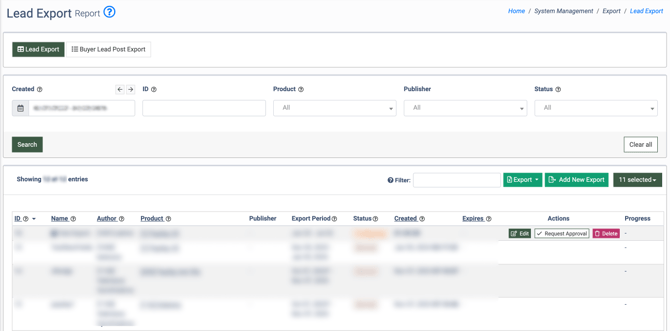
The **“Lead Export”** tab allows you to create the request for the lead export and view the available requests. You can filter out the lead data for export according to the selected Product and Publisher.
The export created in this tab contains the information that is available in the Publisher’s Lead Details report.
[](https://support.phonexa.com/hubfs/oEQLBl4RxJ.png?hsLang=en)
*Note: For security reasons, users can only see the buttons in the* ***“Actions”*** *column for exports they created themselves. The instance owner can view the export actions created by all users.*
You can narrow down the search results by using the following filters:
- **Created:** Select the creation date of the request.
- **ID:** Enter the unique identification number of the request.
- **Product:** Select the Product for the request.
- **Publisher:** Select the Publisher for the request.
- **Status:** Select the status of the request *(Configuring, Waiting for Approval, Pending, Processing, Completed, Error, Declined, Blocked, Expired, Deleted, Aborted, Completed (No Data))*.
The export requests list contains the following information:
- **ID:** The unique identification number of the request.
- **Name:** The name of the request.
- **Author:** The name of the user who created the request.
- **Product:** The name of the Product in the request.
- **Publisher:** The name of the Publisher in the request.
- **Export Period:** The period for the lead export in the request.
- **Status:** The status of the request.
- **Created:** The creation date of the request.
- **Expires:** The date and time when the request expires. Export requests automatically expire one month after they are created for security reasons. *Note: If an export covers a longer date range (for example, two years) but the* ***“Downloads”*** *page contains fewer files than expected, it typically means there were no leads available for the missing months within the selected period.*
To create a new export request, click the **“Add New Export”** button.
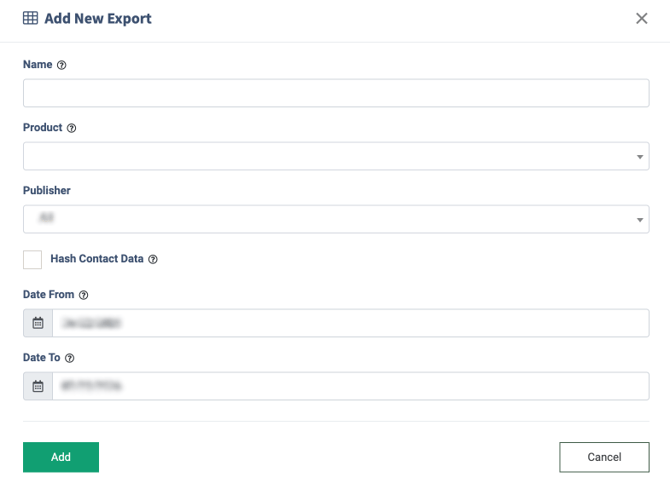
Fill in the following fields in the **“Add New Export”** pop-up window:
- **Name:** Enter the name of the request.
- **Product:** Select the Product for the request.
- **Publisher:** Select the Publisher for the request.
- **Hash Contact Data:** Check the box to hash the contact information, such as phone number and email address, in the exported data.
- **Date From:** Select the start date of the export period.
- **Date To:** Select the last day of the export period.
Click the **“Add”** button to proceed with the action.
[](https://support.phonexa.com/hubfs/jXr6VaZJr9.png?hsLang=en)
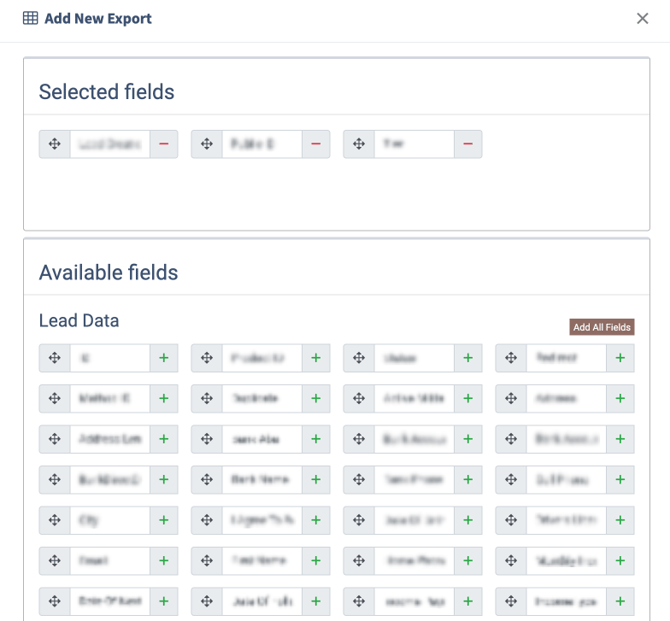
Select the lead details fields that will be included in the export by clicking the **“+”** button, or drag-and-drop them to set the order of the fields in the export report.
The available fields are split into blocks according to their data types and their relations to the user groups and system entities: *Lead Data, Publisher Data, Buyer Data, Earning, Quality.*
To add all fields from the corresponding block, click the **“Add All Fields”** button.
*Note: The list of available fields depends on the Product.*
Click the **“Save”** button to complete the action.
[](https://support.phonexa.com/hubfs/BnbpEdAWxz.png?hsLang=en)
### Buyer Lead Post Export
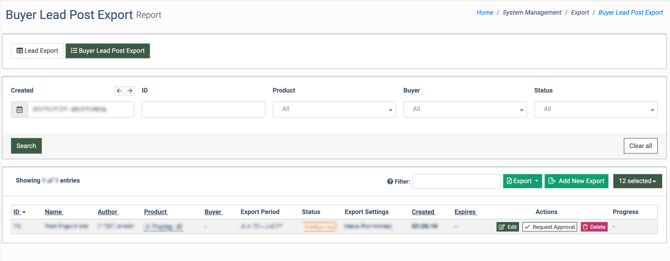
The **“Buyer Lead Post Export”** tab allows you to create the request for the lead export and view the available requests. You can filter out the lead data for export according to the selected Product and Buyer.
The export created in this tab contains the information that is available in the Buyer’s Lead Details report.
This tab allows you to add additional information to the export, such as the details about all posts that were generated from the particular lead and were made to the buyer’s campaigns, data related to the lead processing through the silent campaigns, the lead quality details, such as statuses of the QC and buyer’s dispositions set for the leads, along with the comments attached to the corresponding disposition statuses.
[](https://support.phonexa.com/hubfs/yzxk9gVAQ5.png?hsLang=en)
You can narrow down the search results by using the following filters:
- **Created:** Select the creation date of the request.
- **ID:** Enter the unique identification number of the request.
- **Product:** Select the Product for the request.
- **Buyer:** Select the Buyer for the request.
- **Status:** Select the status of the request *(Configuring, Waiting for Approval, Pending, Processing, Completed, Error, Declined, Blocked, Expired, Deleted, Aborted, Completed (No Data))*.
The export requests list contains the following information:
- **ID:** The unique identification number of the request.
- **Name:** The name of the request.
- **Author:** The name of the user who created the request.
- **Product:** The name of the Product in the request.
- **Buyer:** The name of the Buyer for the request.
- **Export Period:** The period for the lead export in the request.
- **Status:** The status of the request.
- **Export Settings:** Displays which leads were considered for export depending on the processing approach *(Main Processing, Silent Processing).*
- **Main Processing:** The leads were processed through the regular campaigns.
- **Silent Processing:** The leads were processed through the silent campaigns.
- **Created:** The creation date of the request.
- **Expires:** The date and time when the request expires.
To create a new export request, click the **“Add New Export”** button.
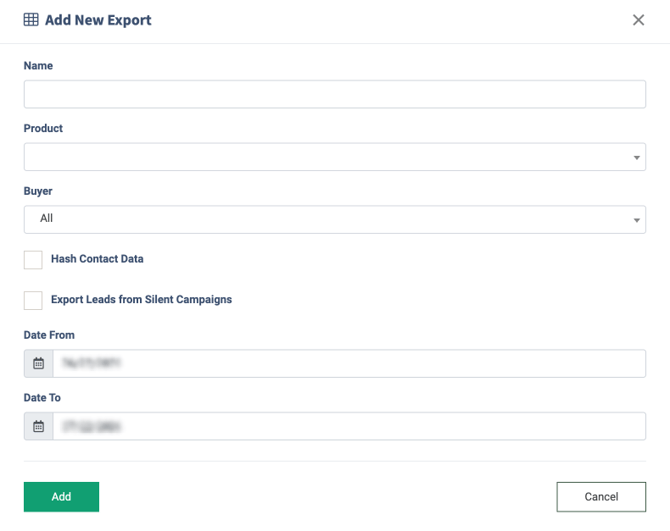
Fill in the following fields in the **“Add New Export”** pop-up window:
- **Name:** Enter the name of the request.
- **Product:** Select the Product for the request.
- **Buyer:** Select the Buyer for the request.
- **Hash Contact Data:** Check the box to hash the contact information, such as phone number and email address, in the exported data.
- **Export Leads from Silent Campaigns:** Check the box to include the lead data from the silent campaigns in the export.
- **Date From:** Select the start date of the export period.
- **Date To:** Select the last day of the export period.
Click the **“Add”** button to proceed with the action.
[](https://support.phonexa.com/hubfs/ezrzVjd1rj.png?hsLang=en)
Select the lead details fields that will be included in the export by clicking the **“+”** button, or drag-and-drop them to set the order of the fields in the export report.
The available fields are split into blocks according to their data types and their relations to the user groups and system entities: *Lead Data, Publisher Data, Buyer Data, Earning, Quality.*
To add all fields from the corresponding block, click the **“Add All Fields”** button.
*Note: The list of available fields depends on the Product.*
Click the **“Save”** button to complete the action.
[](https://support.phonexa.com/hubfs/BnbpEdAWxz.png?hsLang=en)
### How To Manage The Exports
To edit the list of exported fields and change their order, click the **“Edit”** button in the **“Action”** column.
When the request for the export is created, it can be approved or declined by the system owner or data manager.
The **Data Manager** system role is intended for employees who manage lead export processes in the system. *Note: This role is not independent and must be assigned to the user's primary role.*
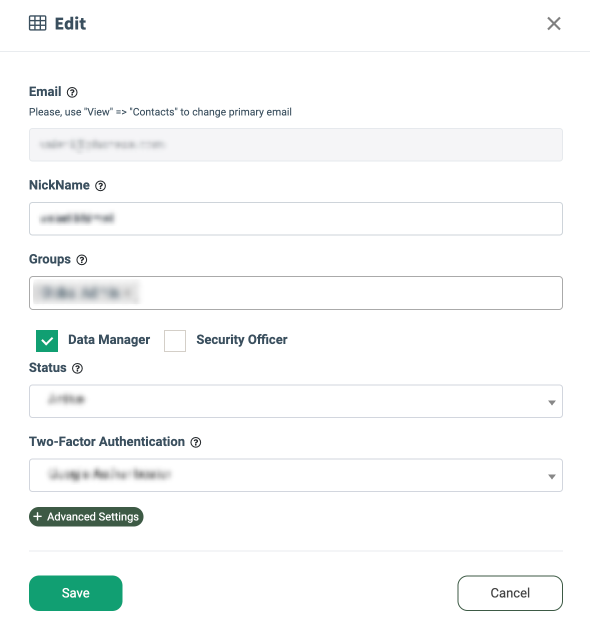
To assign the Data Manager system role to the employee, go to the **System Users \> Employees** section, and click the **“Edit”** button in the **“Actions”** column next to the corresponding employee.
[](https://support.phonexa.com/hubfs/aGxm59maxP.png?hsLang=en)
In the **“Edit”** pop-up window, check the box **“Data Manager”**, and click the **“Save”** button to finish.
You can assign this system role to users with the following primary system roles:
- **Global Admin**;
- **LMS Admin**;
- **Call Logic Admin**.
Now, this user will be included in the list of recipients of a verification code to confirm the Lead Export requested by other users.
*Note: All records on the Lead Export page become available to the user.*
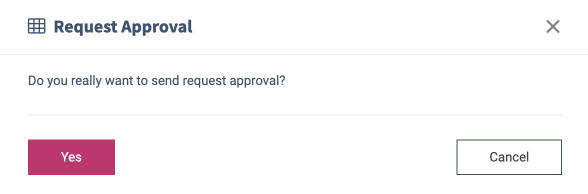
To request approval, click the **“Request Approval”** button in the **“Action”** column. The approval code will be generated and sent to the owner's email address. The approval code is valid for 24 hours, and the owner has only three attempts to enter the code into the system.
[](https://support.phonexa.com/hubfs/XgxKYqN6QG.png?hsLang=en)
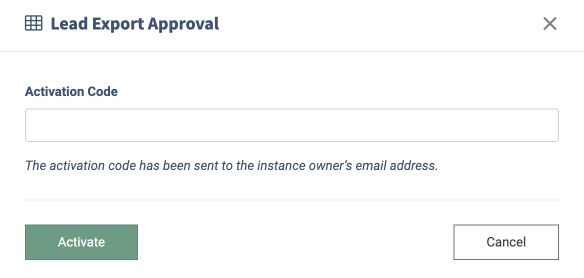
To approve the export request, click the **“Approve”** button in the **“Action”** column, enter the code in the pop-up window, and click **“Activate”**.
[](https://support.phonexa.com/hubfs/oEQLBlnRxJ.png?hsLang=en)
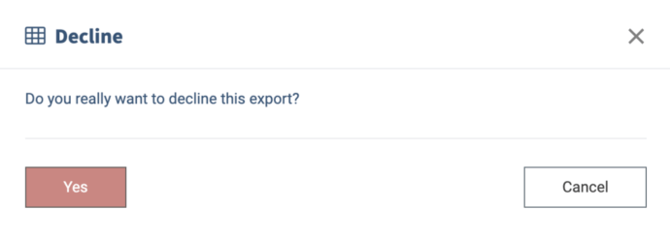
To decline the export request, click the **“Decline”** button in the **“Action”** column.
*Note: This option is available only for the system owner.*
[](https://support.phonexa.com/hubfs/v3QqMkW2QP.png?hsLang=en)
To generate a new code when the previous one is expired, click the **“Generate New Code”** button in the **“Action”** column.
If the wrong code is entered three times, the export request status automatically changes to **“Blocked”**.
To view the list of the exported fields, click the **“View”** button in the **“Action”** column.
[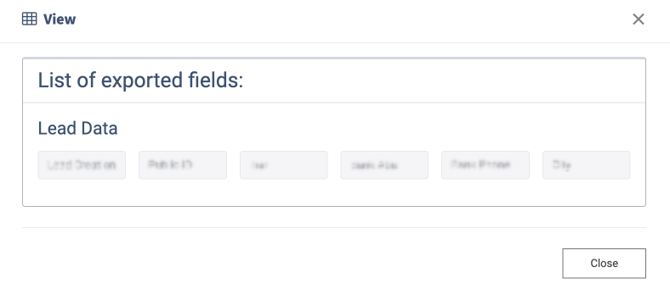](https://support.phonexa.com/hubfs/XgxKYqA6QG.png?hsLang=en)To delete the record from the list, click the **“Delete”** button in the **“Action”** column.
To abort generating the CSV files, click the **“Abort”** button in the **“Action”** column.
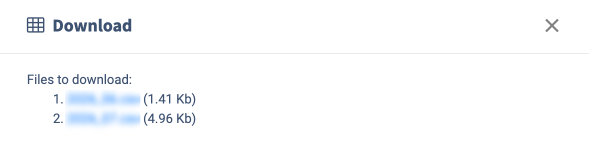
Click the ”**Download”** button in the **“Action”** column to download the CSV files with the export data. Click the name of the CSV file in the **“Download”** pop-up window to start the download.
[](https://support.phonexa.com/hubfs/W7rXB23dbK.png?hsLang=en)
Depending on the report status, the following action buttons are available:
- Forthe **Configuring** status - the **“Delete”**, **“Edit”,** and **“Request Approval”** buttons.
- For the **Waiting for Approval** status - the **“Delete”**, **“Approve”, “Generate New Code”**, **“Decline”**, and **“View”** buttons.
- For the **Pending** status - the **“Abort”** and **“View”** buttons.
- For the **Processing** status - the **“Abort”** and **“View”** buttons.
- For the **Completed** status - the **“Delete”**, **“View”,** and **“Download”** buttons.
- For the **Error** status - the **“View”** button.
- For the **Deleted** status - the **“View”** button.
- For the **Declined** status - the **“View”** button.
- For the **Blocked** status - the **“View”** button.
- For the **Expired** status - the **“View”** button.
- For the **Aborted** status - the **“Delete”** button.
- For the **Completed (No Data)** status *-* the **“View”** button.
- [General information](https://support.phonexa.com/general-information?hsLang=en#main-content)
- [Account Settings](https://support.phonexa.com/general-information?hsLang=en#account-settings)
- [Security Settings](https://support.phonexa.com/general-information?hsLang=en#security-settings)
- [Users](https://support.phonexa.com/general-information?hsLang=en#users)
- [System Customization](https://support.phonexa.com/general-information?hsLang=en#system-customization)
- [Project Customization](https://support.phonexa.com/general-information?hsLang=en#project-customization)
- [Product Customization](https://support.phonexa.com/general-information?hsLang=en#product-customization)
- [System Management](https://support.phonexa.com/general-information?hsLang=en#system-management)
- [Support](https://support.phonexa.com/general-information?hsLang=en#support)
- [LMS Sync & Call Logic](https://support.phonexa.com/lms-sync-call-logic?hsLang=en#main-content)
- [Extra Features](https://support.phonexa.com/lms-sync-call-logic?hsLang=en#extra-features)
- [Publisher Configuration](https://support.phonexa.com/lms-sync-call-logic?hsLang=en#publisher-configuration)
- [Client Management](https://support.phonexa.com/lms-sync-call-logic?hsLang=en#client-management)
- [System Logs](https://support.phonexa.com/lms-sync-call-logic?hsLang=en#system-logs)
- [Documents And References](https://support.phonexa.com/lms-sync-call-logic?hsLang=en#documents-and-references)
- [Reports and Analytics](https://support.phonexa.com/lms-sync-call-logic?hsLang=en#reports-and-analytics)
- [Publisher management](https://support.phonexa.com/lms-sync-call-logic?hsLang=en#publisher-management)
- [Call Logic Customization](https://support.phonexa.com/lms-sync-call-logic?hsLang=en#call-logic-customization)
- [Campaign Configuration](https://support.phonexa.com/lms-sync-call-logic?hsLang=en#campaign-configuration)
- [Feed CMS](https://support.phonexa.com/lms-sync-call-logic?hsLang=en#feed-cms)
- [Event Tracking](https://support.phonexa.com/lms-sync-call-logic?hsLang=en#event-tracking)
- [iClear](https://support.phonexa.com/lms-sync-call-logic?hsLang=en#iclear)
- [E-Delivery](https://support.phonexa.com/e-delivery?hsLang=en#main-content)
- [List Management](https://support.phonexa.com/e-delivery?hsLang=en#list-management)
- [Email Campaigns](https://support.phonexa.com/e-delivery?hsLang=en#email-campaigns)
- [SMS Campaigns](https://support.phonexa.com/e-delivery?hsLang=en#sms-campaigns)
- [Reports](https://support.phonexa.com/e-delivery?hsLang=en#reports)
- [Suppression Management](https://support.phonexa.com/e-delivery?hsLang=en#suppression-management)
- [Books360](https://support.phonexa.com/books360?hsLang=en#main-content)
- [Books 360 Integration](https://support.phonexa.com/books360?hsLang=en#books-360-integration)
- [Vendor Management](https://support.phonexa.com/books360?hsLang=en#vendor-management)
- [Account](https://support.phonexa.com/books360?hsLang=en#account)
- [Customer Management](https://support.phonexa.com/books360?hsLang=en#customer-management)
- [Opt-Intel](https://support.phonexa.com/opt-intel?hsLang=en#main-content)
- [List Management](https://support.phonexa.com/opt-intel?hsLang=en#list-management)
- [All Reports](https://support.phonexa.com/opt-intel?hsLang=en#all-reports)
- [Mailers](https://support.phonexa.com/opt-intel?hsLang=en#mailers)
- [Campaigns](https://support.phonexa.com/opt-intel?hsLang=en#campaigns)
- [System Management](https://support.phonexa.com/opt-intel?hsLang=en#system-management)
- [HitMetrix](https://support.phonexa.com/hitmetrix?hsLang=en#main-content)
- [Analytics](https://support.phonexa.com/hitmetrix?hsLang=en#analytics)
- [Heatmaps](https://support.phonexa.com/hitmetrix?hsLang=en#heatmaps)
- [System Management](https://support.phonexa.com/hitmetrix?hsLang=en#system-management)
- [Lynx](https://support.phonexa.com/lynx?hsLang=en#main-content)
- [Offers](https://support.phonexa.com/lynx?hsLang=en#offers)
- [LYNX Reports](https://support.phonexa.com/lynx?hsLang=en#lynx-reports)
- [Advertisers](https://support.phonexa.com/lynx?hsLang=en#advertisers)
- [Affiliates](https://support.phonexa.com/lynx?hsLang=en#affiliates)
- [Account Settings](https://support.phonexa.com/lynx?hsLang=en#account-settings)
- [Cloud PBX](https://support.phonexa.com/cloud-pbx?hsLang=en)
[](https://phonexa.com/?hsLang=en)
Phonexa Knowledge Base
Copyright © 2026, Phonexa