
The Traffic Flow section provides a collection of reports that help you analyze lead movement, investigate traffic sources, monitor redirect activity, and evaluate Publisher performance. These reports give you greater visibility into how leads enter and move through your system, allowing you to verify traffic quality, identify lead origins, troubleshoot redirect-related issues, and make informed business decisions.
Traffic Flow: Visualize how leads move between Publishers, verify first-look traffic, and identify lead-flow patterns.
Redirect Referrers: Analyze sold leads by redirect referrer domain to evaluate traffic sources and their performance.
Redirect Referrer Domain Search: Search the complete sales history of a specific redirect referrer domain across Publishers, Channels, and Sources.
Expired Redirects: Monitor attempts to access expired Buyer redirect links and investigate delayed redirect activity.
Traffic flow
The Traffic Flow report allows you to view the number of unique leads posted in the system by each particular Publisher, along with a list of other Publishers who have posted the same leads.
The Traffic Flow report analyzes how leads move between publishers within the first minutes after they enter the system. For a selected publisher, the report reconstructs lead-flow scenarios - the ordered paths a lead follows across publishers - and visualizes the most common paths as a traffic funnel.
The report’s primary purpose is first-look verification. A publisher gives you a “first look” when their leads enter your system directly, before being shopped to any other network or buyer. If a publisher claims their traffic is exclusive or first look, the Traffic Flow report shows whether that claim holds: leads whose path starts with Direct reached you first, while leads that arrive through other publishers or networks were seen elsewhere before they reached you.
Benefits
- Verify first-look and exclusivity claims. Confirm whether a publisher’s traffic actually reaches you first or has already passed through other networks.
- Reveal a publisher’s partner network. See which other publishers or networks a publisher works with, based on where their leads appear before and after your system.
- Support payout and pricing negotiations. First-look traffic typically commands premium pricing. Use report data as evidence when discussing rates.
- Detect recycled or resold leads. Identify traffic that circulates between multiple publishers before reaching you, which often correlates with lower quality and contact rates.
Business Use Cases
- Verifying an Exclusive Publisher Relationship: A publisher claims you have an exclusive relationship and receive a first look at all of their traffic. Run the Traffic Flow report for that publisher. If a large share of leads shows Direct as the source - meaning the path consists of the selected publisher only - the claim is supported. If significant volume arrives through other publishers first, for example, 20% of leads pass through another network before reaching the publisher's channel, the traffic is not exclusively first look. You can go back to the publisher with this data and ask why the traffic passes through third parties, or renegotiate terms.
- Identifying Who a Publisher Works With: Use the Immediate sources and Original sources tables to see which publishers and networks appear upstream of the selected publisher. This shows whether the data the publisher sends is originally theirs or acquired from other parties.
To review the report, go to the Analytics and Optimization > Deep Analytics > Traffic flow section, then open the Traffic Flow tab.
You can narrow down the search results using the following filters:
- Date range: Select the date range of the report.
- Publisher: Select the Publisher whose traffic will be analyzed.
- Show funnel for: Select how many top scenarios to visualize (Top 3 scenarios / Top 5 scenarios / Top 7 scenarios / Top 10 scenarios / Top 15 scenarios).
The report displays 4 sections:
Note: These sections are available after selecting a specific publisher, choosing the relevant funnel scenarios, and performing a search.
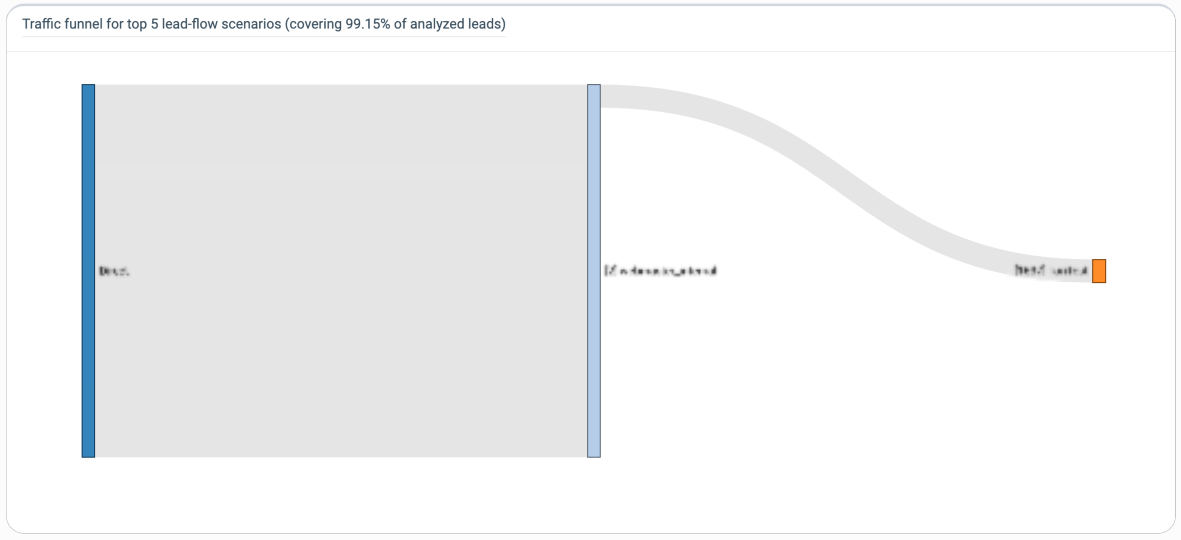
Traffic Funnel: This block displays a Sankey diagram of the selected number of top scenarios. The block header shows the share of analyzed leads these scenarios cover. It allows you to quickly spot if a Publisher is mostly an originator or appears later in chains, and detect sudden changes in traffic patterns.
This is a Sankey diagram, where you read the flows from left to right. Each rectangle represents a point in the lead's journey, and the gray bands show how leads move from one Publisher to the next. The thicker the band, the more leads followed that path.
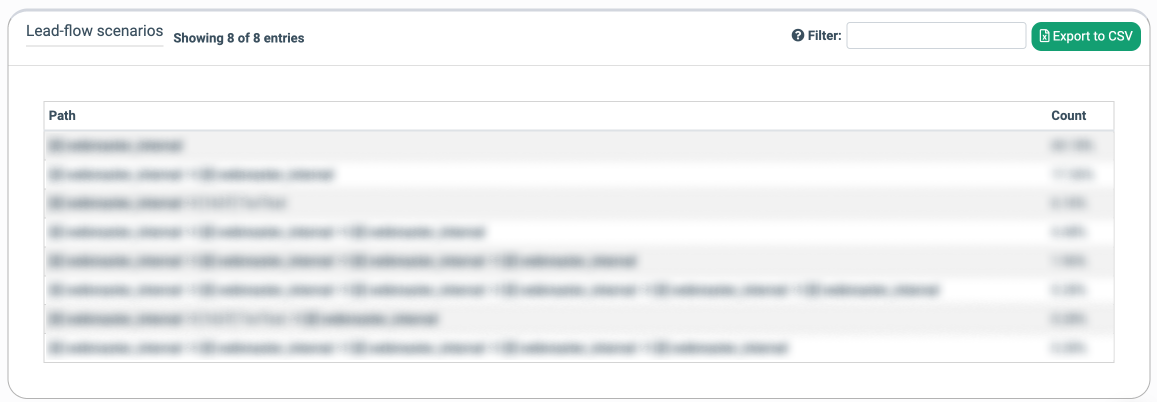
Lead-flow scenarios: This block allows you to view every analyzed path in detail. It represents an ordered sequence of publishers the lead passed through. A path consisting of only the selected publisher means the lead entered directly (first look).
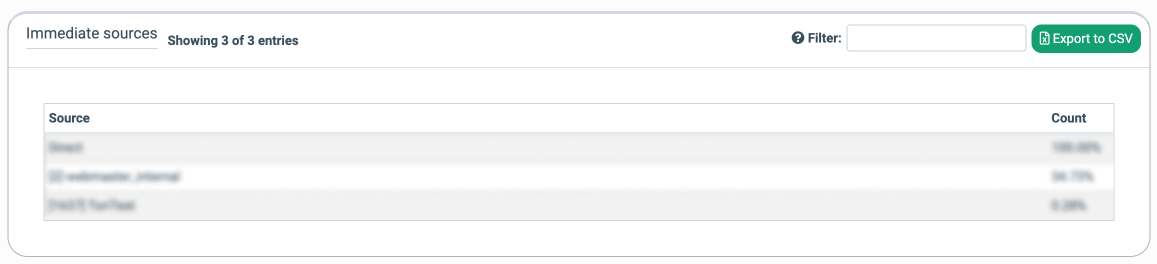
Immediate sources: This block displays the Publishers that most frequently appear immediately before the selected Publisher in the lead-flow path. It shows where the selected Publisher receives its traffic from and the percentage of analyzed leads associated with each immediate source. Use this information to identify direct upstream traffic partners and better understand how leads reach the selected Publisher.
Original sources: This block allows you to see the Publishers who post the leads (first look), so you can analyze Publisher performances in depth. It allows you to rate the quality and exclusivity of leads received from the Publisher, and identify opportunities to work directly with originators instead of intermediaries.

Referrer for Redirects
The “Referrer for Redirects” tab allows you to analyze the effectiveness of sold leads at the redirect referrer domain level (the domain from which a visitor was redirected before the lead was generated and sold) to understand traffic quality and sales sources to understand which ones drive sales.
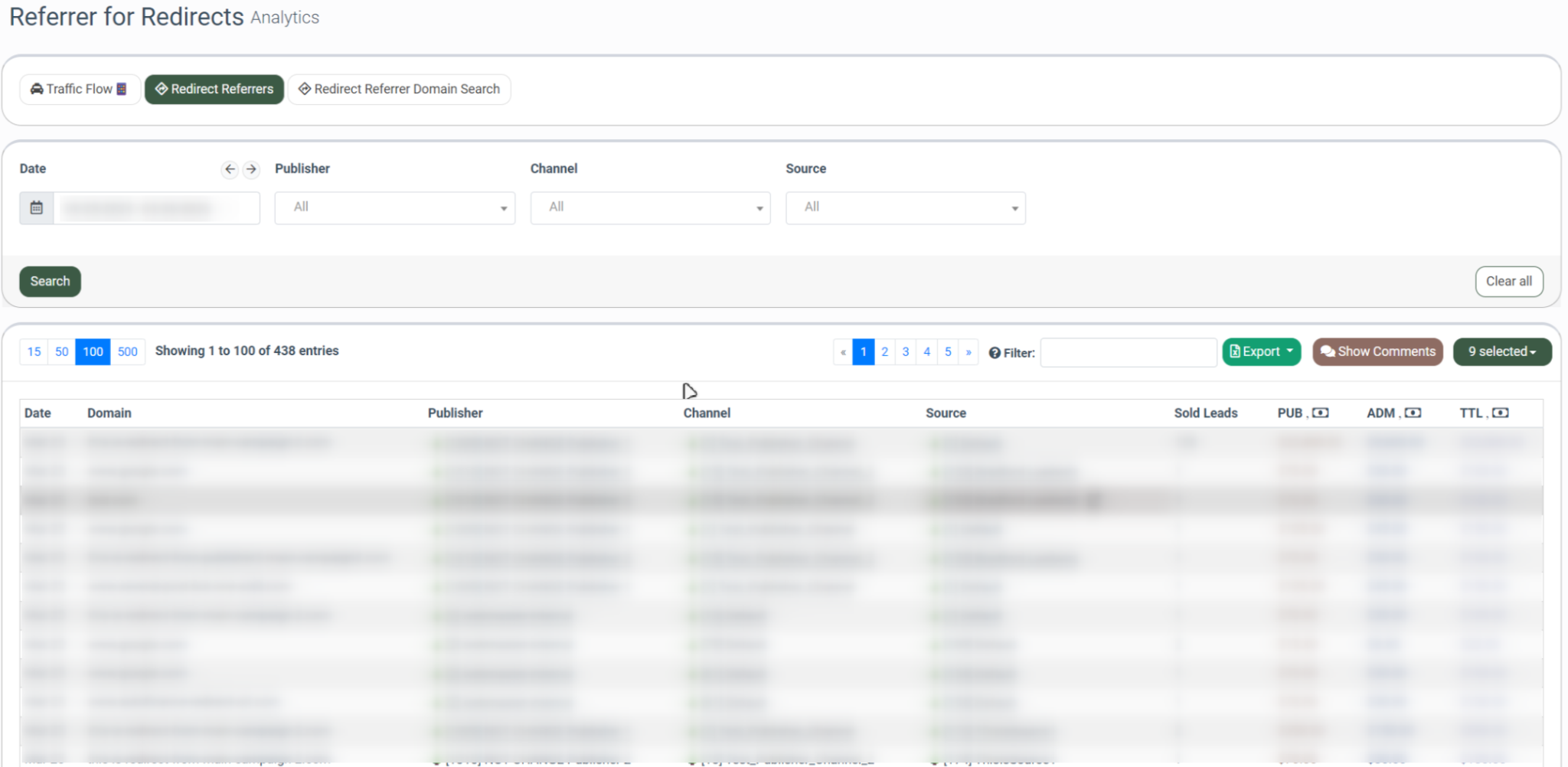
This tab contains the following information:
- Date: The date of data aggregation.
- Domain: The domain extracted from the referrer URL during redirect.
- Publisher: The name of the Publisher.
- Channel: The name of the Publisher Channel.
- Source: The name of the Publisher Source.
- Sold Leads: The number of sold leads.
- PUB, $: The Publisher earnings.
- ADM, $: The Admin payment.
- TTL, $: The total payment.
You can narrow down the search results using the following filters:
- Date: Select the date range of the report.
- Publisher: Select the Publisher.
- Channel: Select the Publisher Channel.
- Source: Select the Publisher Source.
Redirect Referrer Domain Search
The “Redirect Referrer Domain Search” tab allows you to search and analyze the history for a specific referrer domain (the domain from which a visitor was redirected before the lead was generated and sold) over a time period. It lets you find all records associated with a selected domain, regardless of the specific publisher, channel, or source, providing a complete sales history. This includes every date, publisher, channel, and source through which leads from that domain were sold, allowing you to quickly investigate a single traffic source.
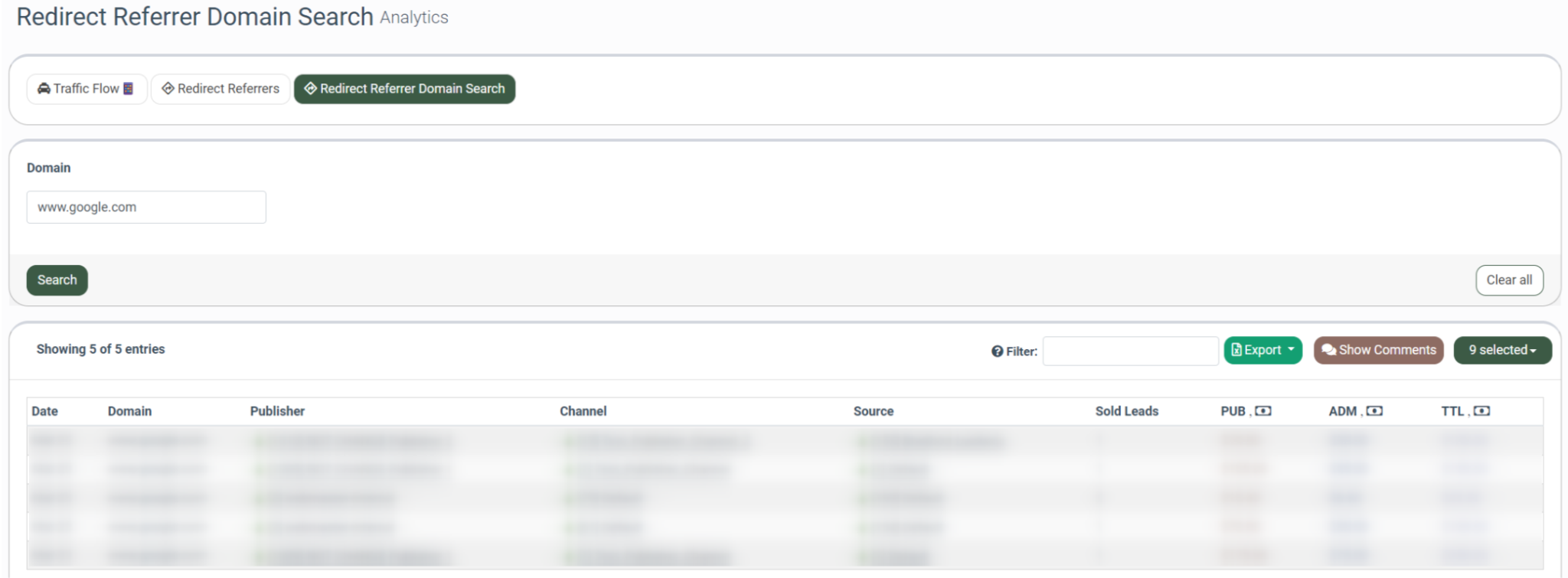
This tab contains the following information:
- Date: The date of data aggregation.
- Domain: The domain extracted from the referrer URL during redirect.
- Publisher: The name of the Publisher.
- Channel: The name of the Publisher Channel.
- Source: The name of the Publisher Source.
- Sold Leads: The number of sold leads.
- PUB, $: The Publisher earnings.
- ADM, $: The Admin payment.
- TTL, $: The total payment.
You can narrow down the search results using the following filters:
- Domain: Enter the domain.
Click the “Search” button to apply the filter.
Expired Redirects
The Expired Redirects report helps you identify and analyze attempts to access Buyer redirect links after they have expired. This report provides visibility into post-sale lead activity and allows you to investigate delayed interactions, monitor traffic behavior, and troubleshoot redirect-related issues.
By reviewing expired redirect attempts, you can gain a better understanding of how leads interact with your campaigns after submission and identify potential issues affecting the user journey.
By default, redirect links remain active for 15 minutes after the lead is sold. If the lead follows the redirect link within this time, they are redirected to the Buyer’s page and are not included in this report. However, if the lead accesses the redirect link after the expiration period (up to 5 days later), the event is recorded in the Expired Redirects report.
Here’s how you can utilize this report:
- Monitor leads that attempted to access expired buyer redirect links.
- Analyze expired redirect activity by Product, Publisher, Channel, Source, and posting method.
- Identify delayed lead interactions and investigate redirect expiration behavior.
- Review revenue-related metrics associated with expired redirect activity.
- Generate filtered reports for analysis and troubleshooting using parameters such as Lead ID, Product, Publisher, and date range.
To view the report, go to the Analytics and Optimization > Deep Analytics > Traffic Flow section, and select the “Expired Redirects” tab.
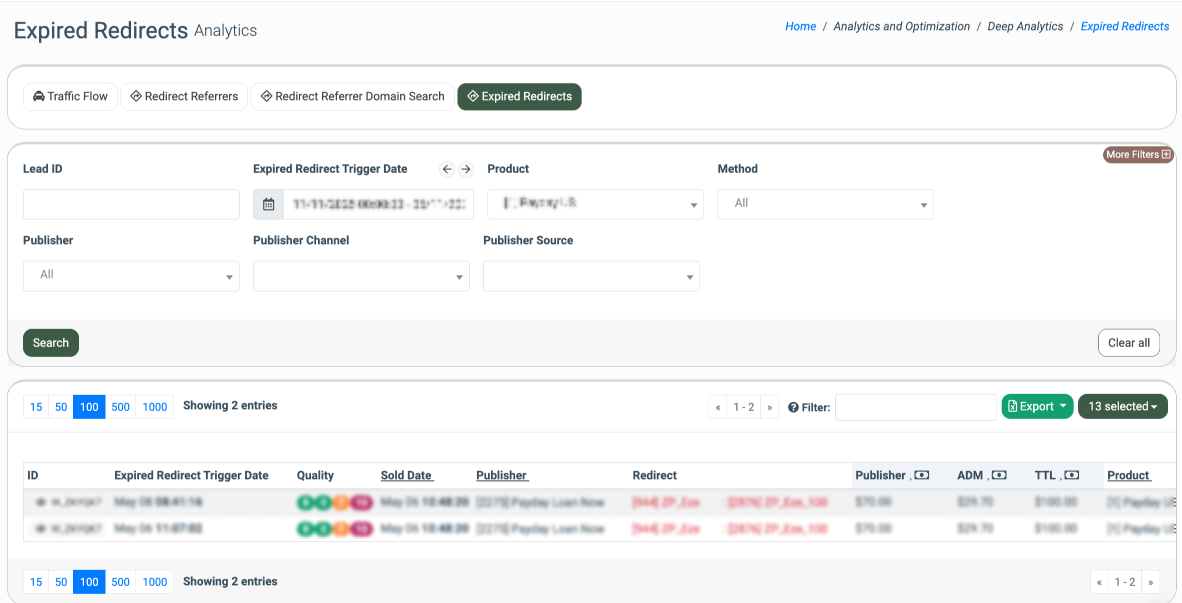
The Expired Redirects report contains the following information:
- ID: The identification number of the lead.
- Expired Redirect Trigger Date: Date and time when the expired redirect link was accessed.
- Quality: Indicates the number of times the same lead has previously been recorded in the system:
- 1st left bubble - within the last 24 hours
- 2nd from left - within the last two weeks
- 3rd from left - within the last 30 days
- 4th from left - within the last 45 days
- Sold Date: The date and time when the lead has been sold.
- Publisher: The name of the Publisher.
- Redirect: The Buyer and the Campaign name the lead has been sold to.
- Publisher, $: The Publisher earnings.
- ADM, $: Admin revenue.
- TTL, $: Total revenue.
- Product: The name of the Product.
- Channel: The name of the Publisher Channel.
- Method: The posting method for the lead. The POST method indicates that the lead was posted to the system via API, and the FORM method indicates that the lead was posted via the Phonexa form.
- Source: The source of the Publisher.
You can generate a detailed report using the following filters:
- Lead ID: Enter the identification number of the lead.
- Expired Redirect Trigger Date: Select the date range when the expired redirect link was accessed.
- Product: Select the Product.
- Method: Select the posting method for the lead.
- Publisher: Select the Publisher.
- Publisher Channel: Select the Publisher Channel.
- Publisher Source: Select the Publisher Source.