---
title: Affiliate Management
description: The Affiliate Management section allows you to search, manage existing Affiliates and create new Affiliates.
---
[Skip to content](https://support.phonexa.com/affiliate-management#main-content)
[](https://support.phonexa.com/?hsLang=en)
Open main navigation
Close main navigation
- [➜\]](https://phonexa.com/)
[➜\]](https://phonexa.com/?hsLang=en)
Phonexa Support Center
- There are no suggestions because the search field is empty.
1. [Knowledge Base](https://support.phonexa.com/?hsLang=en)
2. [Lynx](https://support.phonexa.com/lynx?hsLang=en)
3. [Affiliates](https://support.phonexa.com/lynx?hsLang=en#affiliates)
# Affiliate Management
## The Affiliate Management section allows you to search, manage existing Affiliates and create new Affiliates.
- [Affiliate Management List](https://support.phonexa.com/affiliate-management#list)
- [How to create an Affiliate](https://support.phonexa.com/affiliate-management#create)
- [How to view Affiliate information](https://support.phonexa.com/affiliate-management#view)
- [How to edit an Affiliate](https://support.phonexa.com/affiliate-management#edit)
#### Affiliate Management List
To view the **Affiliate Management** list, go to the **Affiliates \> Affiliate Management** section.
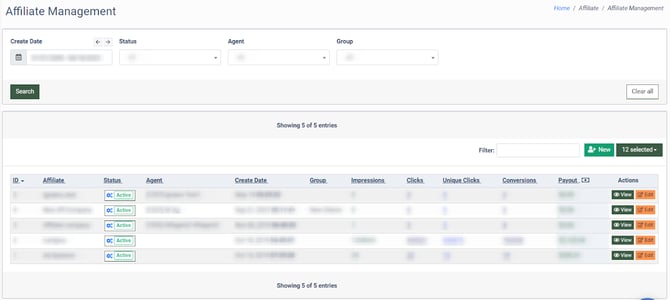The **Affiliates Management** list contains the following information:
- **ID**:The unique identification number of the Affiliate.
- **Affiliate**: The name of the Affiliate.
- **Status**: The status of the Affiliate (*Active, Pending, Blocked, Deleted).*
- **Agent**: The ID number and the name of the connected Agent.
- **Create Date:** The date and time of the Affiliate creation.
- **Group**: The Affiliate group. *Read more about the Affiliate Groups in this Knowledge Base* [*article*](https://support.phonexa.com/groups?hsLang=en)*.*
- **Impressions**: The number of advertiser links displayed on the websites.
- **Clicks**: The number of clicks on the advertiser links.
- **Unique Clicks**: The number of unique clicks on the advertiser links.
- **Conversion**: The ratio of the number of click-throughs with the following purchase to the total number of clicks.
- **Payout**: The amount of the Affiliate payout.
You can narrow down the search results by using the following filters:
- **Create Date**: Select the date range of the Affiliate creation.
- **Status**: Select the status of the Affiliate (*Active, Pending, Blocked, Deleted)*.
- **Agent**: Select the Affiliate agent.
- **Group**: Select the Affiliate group.
#### How to create an Affiliate
To create a new Affiliate, click the “**New**” button and fill in the following fields in the “**New Affiliate**” pop-up window:
- **Affiliate**: Enter the name of the Affiliate.
- **Status**: Select the status for the Affiliate (*Active, Pending, Blocked, Deleted).*
- **Agent**: Select the Affiliate Agent from the drop-down list.
- **Email**: Enter the email address.
- **Country**: Select the country for the Affiliate.
- **Group**: Select the Affiliate group.
- **City**: Select the city for the Affiliate.
- **Address 1**: Enter the address.
- **Address 2**: Enter the address (*not mandatory*).
- **Zipcode**: Enter the zip code.
- **Phone**: Enter the phone number (*Format +\[country code\]\[area code\]\[phone number\]. Must be between 10-15 digits*).
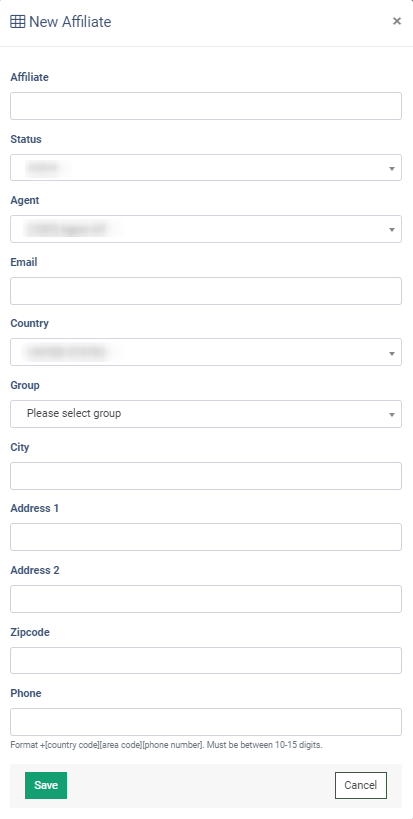
Click the “**Save**” button to create the Affiliate.
*Read more on how to create users for the Affiliate in this Knowledge Base* [*article*](https://support.phonexa.com/how-to-create-affiliate-user?hsLang=en)*.*
#### How to view Affiliate information
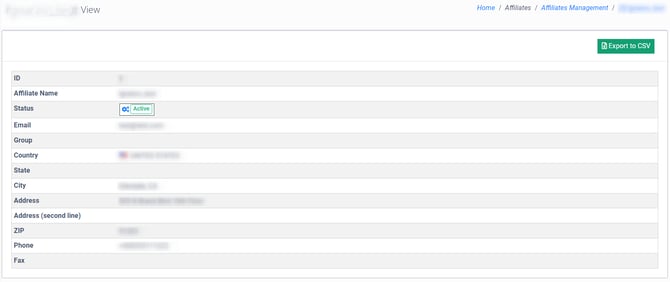
To check the information of the specific Affiliate, click the “**View**” button in the “**Actions**” column. The Affiliate view tab contains the following information:
- **ID**: The unique identification number of the Affiliate.
- **Affiliate’s Name**: The first and last name of the Affiliate.
- **Status**: The status of the Affiliate.
- **Email**: The email address of the Affiliate.
- **Group:** The Affiliate group.
- **Country**: The country of the Affiliate.
- **State**: The state of the Affiliate.
- **City**: The city of occupation.
- **Address**: The address of the Affiliate.
- **Address (second line)**: The address of the Affiliate.
- **Zip code**: The zip code of the Affiliate.
- **Phone**: The phone number of the Affiliate.
- **Fax**: The fax number.
#### How to edit an Affiliate
Click the “**Edit**” button in the “**Actions**” column to edit information about the Affiliate.
The **General** tab contains the following fields:
- **Affiliate**: Enter the name of the Affiliate.
- **Status**: Select the status for the Affiliate (*Active, Pending, Blocked, Deleted).*
- **Agent**: Select the Affiliate Agent from the drop-down list.
- **Email**: Enter the email address.
- **Country**: Select the country for the Affiliate.
- **Group**: Select the Affiliate group.
- **City**: Select the city for the Affiliate.
- **Address 1**: Enter the address.
- **Address 2**: Enter the address (*not mandatory*).
- **Zipcode**: Enter the zip code.
- **Phone**: Enter the phone number (*Format +\[country code\]\[area code\]\[phone number\]. Must be between 10-15 digits*).
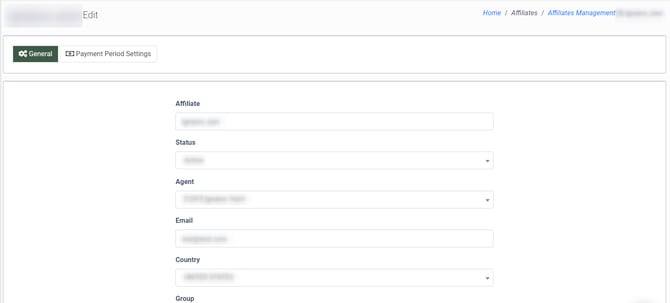The **Payment Period Settings** tab contains the following fields:
- **Hold**: The hold time for payout.
- **Pay Period**: The payout frequency (*manual, weekly, biweekly, monthly, semimonthly).*
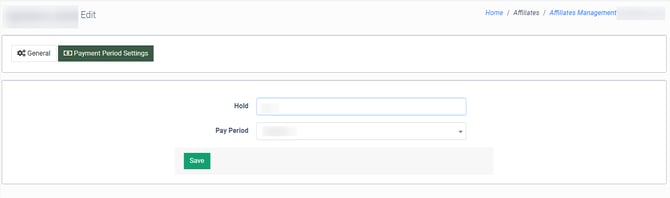Click the “**Save**” button to proceed with the changes.
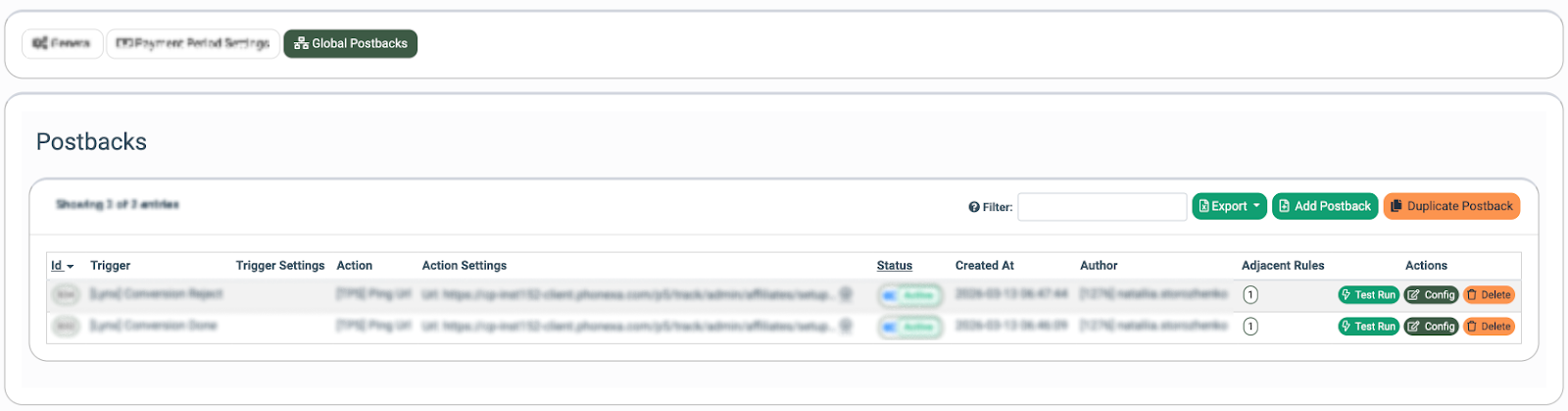
The **“Global Postbacks”** tab allows you to create postbacks once at the advertiser level so that you can apply them to all the offers, instead of configuring them separately for each offer.
*Read more about the postbacks in the following Knowledge Base*[*article*](https://support.phonexa.com/postbacks?hsLang=en)*.*
[](https://support.phonexa.com/hubfs/undefined-Mar-16-2026-02-31-09-2126-PM.png?hsLang=en)
The list of postbacks contains the following information:
- **ID:** The unique identification number of the postback.
- **Trigger:** The name of the trigger.
- **Trigger Settings:** The combination of the general postback trigger settings for which the conversions are tracked.
- **Action:** The name of the action.
- **Action Settings:** The list of the action postback settings, such as method and URL.
- **Status (Active / Disabled):** The status of the postback. *Note: To change the postback status, click the corresponding button and select the status in the pop-up window.*
- **Created At:** The date and time of the postback creation.
- **Author:** The ID and name of the user who created a postback.
- **Adjacent Rules:** The number of postbacks that can be applied simultaneously with the selected postback. Click on the number to see the list of postbacks that can run concurrently.
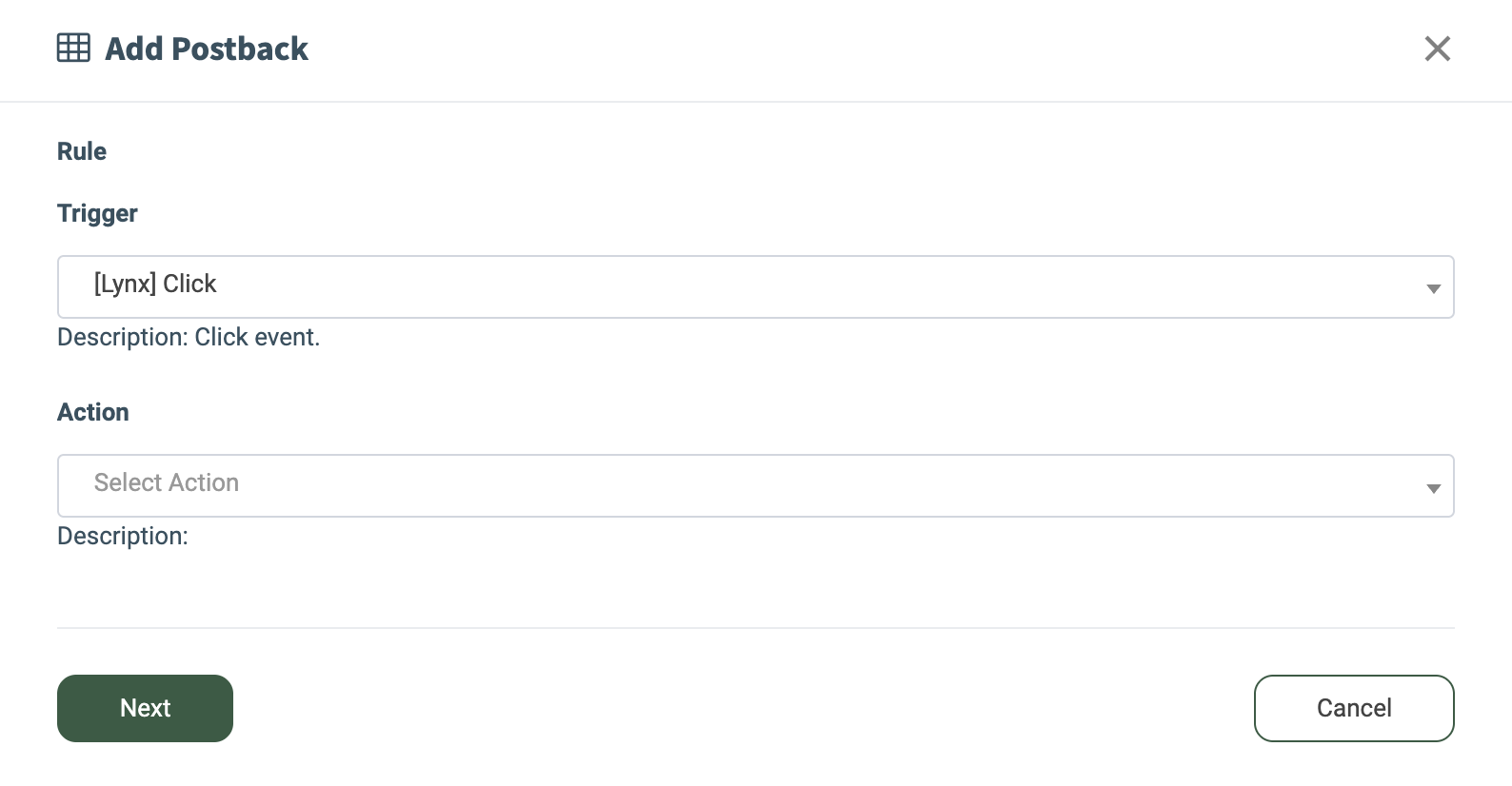
To create a new postback, click the **“Add Postback”** button. Fill in the following fields in the **“New Postback”** pop-up window:
- **Trigger:** Select the postback trigger.
- **\[Lynx\] Conversion Done:** The Lynx conversion is completed.
- **\[Lynx\] Conversion Reject:** The Lynx conversion is rejected.
- **\[Lynx\] Conversion Pending:** The Lynx conversion is pending.
- **\[Lynx\] Click:** The click event happened.
- **Action:** Select the action that determines the way to transfer the conversion data
*Read more about available actions for the Postback tracking in the following Knowledge Base* [*article*](https://support.phonexa.com/postbacks?hsLang=en)*.*
Click the **“Next”** button to proceed.
*Follow the instructions from the Knowledge Base* [*article*](https://support.phonexa.com/postbacks?hsLang=en)*to complete the Postback creation.*
To configure the postback, click the **“Config”** button in the **“Actions”** column. Perform the corresponding changes to the fields that are available depending on the previous postback selection, and click the **“Save Rule”** button to complete the action, or click the **“Cancel”** button to close the window.
*Read more about the Postback rule configuration in the following Knowledge Base* [*article*](https://support.phonexa.com/postbacks?hsLang=en)*.*
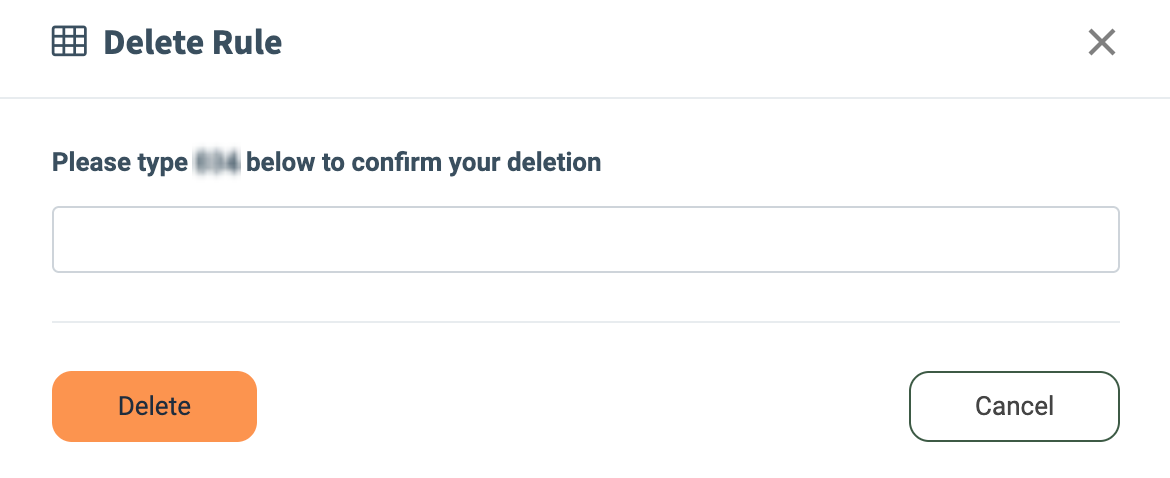
To remove the postback, click the **“Delete”** button in the **“Actions”** column. Enter the generated number into the pop-up window and click the **“Delete”** button.
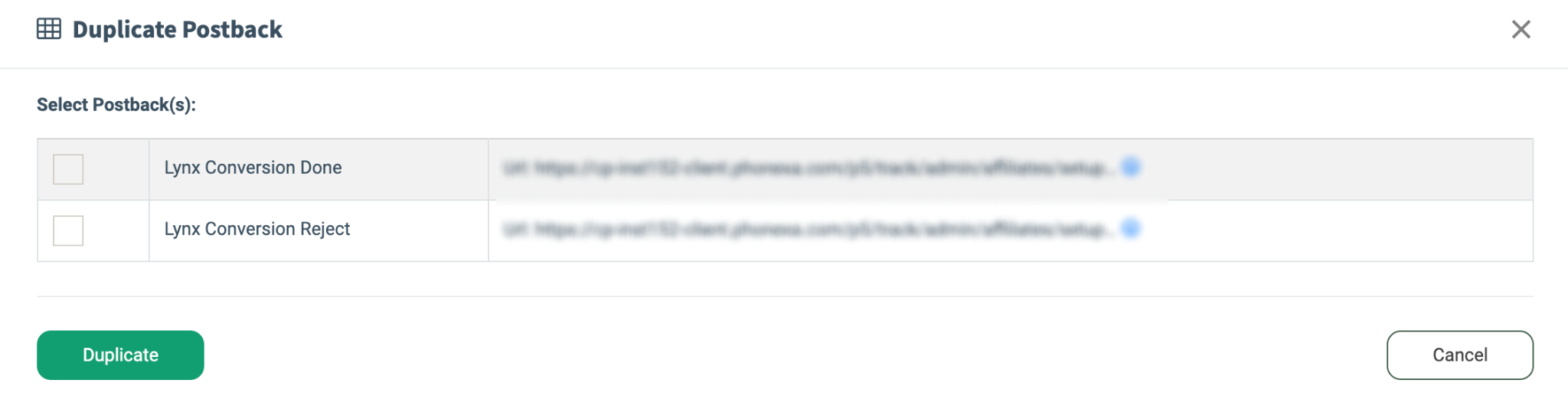
To create a duplicate of the postback, click the **“Duplicate Postback”** button. Check the boxes next to the postbacks you wish to duplicate and click the **“Duplicate”** button to perform the action.
- [General information](https://support.phonexa.com/general-information?hsLang=en#main-content)
- [Account Settings](https://support.phonexa.com/general-information?hsLang=en#account-settings)
- [Security Settings](https://support.phonexa.com/general-information?hsLang=en#security-settings)
- [Users](https://support.phonexa.com/general-information?hsLang=en#users)
- [System Customization](https://support.phonexa.com/general-information?hsLang=en#system-customization)
- [Project Customization](https://support.phonexa.com/general-information?hsLang=en#project-customization)
- [Product Customization](https://support.phonexa.com/general-information?hsLang=en#product-customization)
- [System Management](https://support.phonexa.com/general-information?hsLang=en#system-management)
- [Support](https://support.phonexa.com/general-information?hsLang=en#support)
- [LMS Sync & Call Logic](https://support.phonexa.com/lms-sync-call-logic?hsLang=en#main-content)
- [Extra Features](https://support.phonexa.com/lms-sync-call-logic?hsLang=en#extra-features)
- [Publisher Configuration](https://support.phonexa.com/lms-sync-call-logic?hsLang=en#publisher-configuration)
- [Client Management](https://support.phonexa.com/lms-sync-call-logic?hsLang=en#client-management)
- [System Logs](https://support.phonexa.com/lms-sync-call-logic?hsLang=en#system-logs)
- [Documents And References](https://support.phonexa.com/lms-sync-call-logic?hsLang=en#documents-and-references)
- [Reports and Analytics](https://support.phonexa.com/lms-sync-call-logic?hsLang=en#reports-and-analytics)
- [Publisher management](https://support.phonexa.com/lms-sync-call-logic?hsLang=en#publisher-management)
- [Call Logic Customization](https://support.phonexa.com/lms-sync-call-logic?hsLang=en#call-logic-customization)
- [Campaign Configuration](https://support.phonexa.com/lms-sync-call-logic?hsLang=en#campaign-configuration)
- [Feed CMS](https://support.phonexa.com/lms-sync-call-logic?hsLang=en#feed-cms)
- [Event Tracking](https://support.phonexa.com/lms-sync-call-logic?hsLang=en#event-tracking)
- [iClear](https://support.phonexa.com/lms-sync-call-logic?hsLang=en#iclear)
- [E-Delivery](https://support.phonexa.com/e-delivery?hsLang=en#main-content)
- [List Management](https://support.phonexa.com/e-delivery?hsLang=en#list-management)
- [Email Campaigns](https://support.phonexa.com/e-delivery?hsLang=en#email-campaigns)
- [SMS Campaigns](https://support.phonexa.com/e-delivery?hsLang=en#sms-campaigns)
- [Reports](https://support.phonexa.com/e-delivery?hsLang=en#reports)
- [Suppression Management](https://support.phonexa.com/e-delivery?hsLang=en#suppression-management)
- [Books360](https://support.phonexa.com/books360?hsLang=en#main-content)
- [Books 360 Integration](https://support.phonexa.com/books360?hsLang=en#books-360-integration)
- [Vendor Management](https://support.phonexa.com/books360?hsLang=en#vendor-management)
- [Account](https://support.phonexa.com/books360?hsLang=en#account)
- [Customer Management](https://support.phonexa.com/books360?hsLang=en#customer-management)
- [Opt-Intel](https://support.phonexa.com/opt-intel?hsLang=en#main-content)
- [List Management](https://support.phonexa.com/opt-intel?hsLang=en#list-management)
- [All Reports](https://support.phonexa.com/opt-intel?hsLang=en#all-reports)
- [Mailers](https://support.phonexa.com/opt-intel?hsLang=en#mailers)
- [Campaigns](https://support.phonexa.com/opt-intel?hsLang=en#campaigns)
- [System Management](https://support.phonexa.com/opt-intel?hsLang=en#system-management)
- [HitMetrix](https://support.phonexa.com/hitmetrix?hsLang=en#main-content)
- [Analytics](https://support.phonexa.com/hitmetrix?hsLang=en#analytics)
- [Heatmaps](https://support.phonexa.com/hitmetrix?hsLang=en#heatmaps)
- [System Management](https://support.phonexa.com/hitmetrix?hsLang=en#system-management)
- [Lynx](https://support.phonexa.com/lynx?hsLang=en#main-content)
- [Offers](https://support.phonexa.com/lynx?hsLang=en#offers)
- [LYNX Reports](https://support.phonexa.com/lynx?hsLang=en#lynx-reports)
- [Advertisers](https://support.phonexa.com/lynx?hsLang=en#advertisers)
- [Affiliates](https://support.phonexa.com/lynx?hsLang=en#affiliates)
- [Account Settings](https://support.phonexa.com/lynx?hsLang=en#account-settings)
- [Cloud PBX](https://support.phonexa.com/cloud-pbx?hsLang=en)
[](https://phonexa.com/?hsLang=en)
Phonexa Knowledge Base
Copyright © 2026, Phonexa