
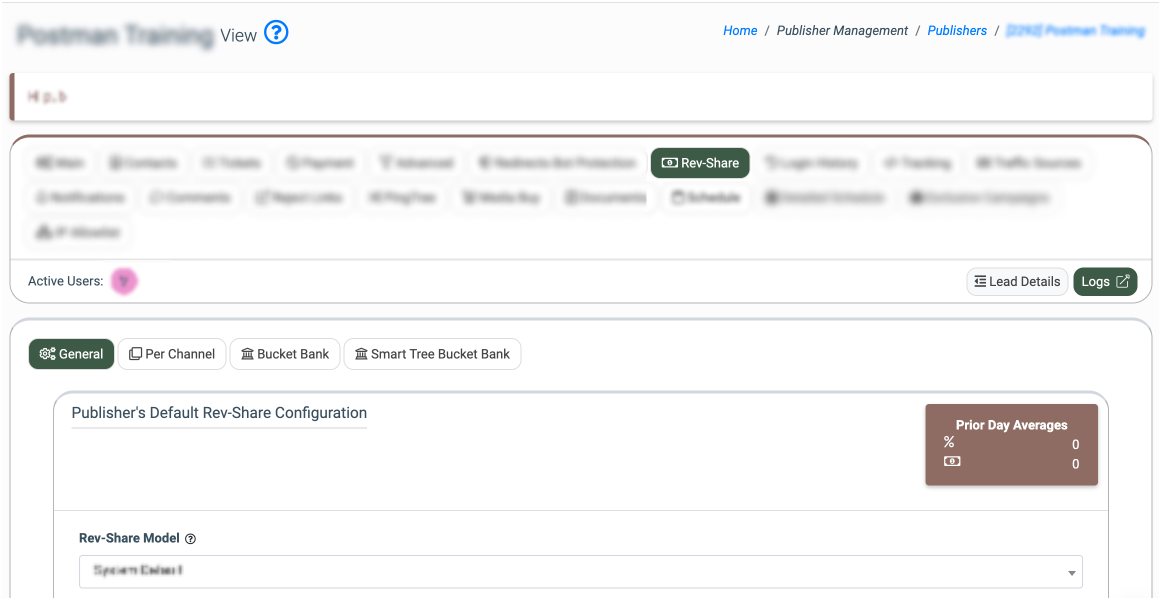
To view the Rev-Share settings, go to the Publisher Management > Publishers section, select the Publisher, and click the “View” button in the “Actions” column. Navigate to the “Rev-Share” tab.
General
In the “General” tab, you can set one of the following Rev-Share Models:
- Static Percent: Select this model to set the static revenue percent for the Publisher.
- Floating Percent: Select this model to set the revenue percent range. When selected, the Rev-Share percentage for each lead is randomly picked from the pre-set range.
- System Default: Select this model to use the system default percent. (To view or manage the value of the default percent, go to the System Management > Project Settings > LMS & Call Logic tab > Publisher settings subtab and check the “Default Earning Percent” field in the General Settings block.)
- Fixed Price: Select this model to set a fixed price for leads. Note: If the Campaign’s Min Price is lower than the Publisher’s fixed price, leads from this Publisher won’t get presented to the Campaign.
- Fixed Price Min/Max: Select this Rev-Share model to set the minimum and maximum fixed price for the Publisher (if the sold price is greater than or equal to the Fixed Max Price the Publisher will be paid the Fixed Max Price, if the sold price is less than the Fixed Max Price but greater than or equal to the Fixed Min Price the publisher will be paid the Fixed Min Price). Note: This Rev-Share model will not work for the Ping-Post Products.
You can select the following additional settings:
- Fixed Payout for Dynamic Campaigns: When enabled, Publisher earnings will be calculated based on the Сampaign’s Min Price settings, regardless of the final sale price.
- Strict Revshare on Tiers: When enabled, the Publisher earnings will be calculated according to the selected Rev-Share model based on the Сampaign’s min price, regardless of the lead tier price (Publisher min price for a lead).
Example: There is a Campaign with a Min Price of $100. The Publisher Rev-Share is set to 50%. The Publisher sent a lead with a minimum price (tier) of $85. If the setting is disabled, the received lead will be sold for 85$ to this Campaign based on the requested price. If the setting is enabled, the received lead will not get presented to this Campaign, as the estimated Publisher earnings according to Rev-Share settings will be $50 (50% of the Campaign's Min Price of $100), which is lower than the requested price. - Strict Revshare on Price Rejects: Similar to the “Strict Rev-Share on Tiers” but applies to leads that were price-rejected. It can be enabled only with the “Strict Rev-Share on Tiers” option enabled as well.
- Enable Rev-Share per Buyer`s Campaign: This option allows you to set a specific Rev-Share model for the selected Campaigns.
Note: This option is available and active for the “Fixed Price” Rev-Share model only. For the “Static Percent” and “Floating Percent” models, there should be Campaigns where this Publisher has posted a lead within the past 7 days to activate the check box. The Сampaigns are grouped based on the Publisher's tiers, and under each tier, we group only those Campaigns to which the lead has been presented based on the Campaign's Min Price. When enabled, you can set a fixed price for the particular Campaign by entering the price value into the “Set Fixed Price” field. Click the “Save” button to complete the action. - Ignore Publisher Price: This option allows you to ignore the price sent by the Publisher and pay the Publisher the amount equal to the fixed price.
Example: The Publisher sends a lead with the price 15$. When the “Ignore Publisher Price” checkbox is marked, the lead can be sold to the Campaign with the fixed price = 10$, and the Publisher's earnings will be 10$ despite the price he sent. - Reject if the Ping price is lower than the Fixed Price: This option ensures that leads are only processed if the incoming Ping price meets or exceeds the defined Fixed Price. When enabled, the system will automatically reject any lead where the Ping price is lower than the specified Fixed Price, preventing underpriced leads from being sold.
Example: A Fixed Price of $10 is set. If a Publisher sends a lead with a Ping price of $8, the lead will be rejected. If the Ping price is $10 or higher, the lead will be processed as usual.
Note: This option is enabled by default for the “Fixed Price” model.
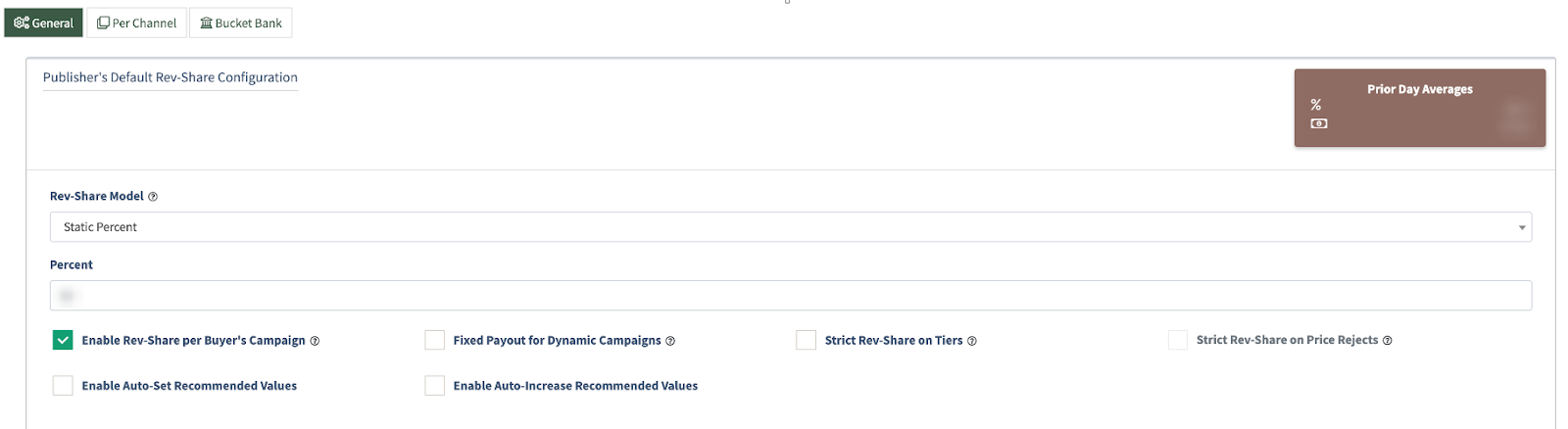
- Enable Auto-Set Recommended Values: This option allows you to set the rev-share percentage for publishers to the recommended values, regardless of the current effective values. When enabled, the publisher will receive payouts based on the recommended rev-share value instead of the current effective value. If this option is disabled, the rev-share percentage will be calculated based on the effective value. However, if the rev-share percentage for a specific tier has been manually set, the manually entered value will take precedence over the recommended value.
Note: This option is available on demand. Please contact your account manager to enable it. - Enable Auto-Increase Recommended Values: This option allows you to increase the rev-share value for tiers up to the recommended values in case the current effective value is lower. It will not apply the recommended values for all tiers but will instead increase the value to the recommended level only for those tiers where the current effective value is below the recommended one. If the rev-share value has been manually set for a particular tier, the manually entered value will take precedence over the recommended one.
Note: This option is available on demand. Please contact your account manager to enable it.
Note: You can enable only one of the following options: “Enable Auto-Set Recommended Values” or “Enable Auto-Increase Recommended Values”. You can not enable both options simultaneously.
- Also copy (overwrite) all records to the following publisher(s): This option allows you to copy the Rev-Share settings for the selected Publishers. Note: When enabled, the previous Rev-Share settings for the selected Publishers will be overwritten.
You can configure Smart Tree settings for the “Static Percent” Rev-Share model. Read more about the Smart Tree configuration in this Knowledge Base article.
The “Rev-Share Types” setting is available only for the Smart Tree Products with the “Static Percent” Rev-Share model set for the Publisher.
Note: If the Smart Tree Bucket Bank is configured, its settings will be used for the Publisher's payout with a higher priority than the Rev-Share Types of the Smart Tree Settings. Read more about the Smart Tree Bucket Bank feature in this Knowledge Base article.
You can set the following Rev-Share Types:
- Strict Profit: Select this option to send a reject to the Publisher when the Publisher's earnings based on the Sold Price are less than expected (based on the ping price). In this case, the Publisher's expected earnings are accumulated in the Smart Tree Bucket Bank (if configured).
- Dynamic Profit: Select this option to allow charging the Admin's revenue to cover the expected Publisher's earnings. (The Admin's revenue can go down to 0 but never goes to a negative balance. If the Admin's revenue is not enough, the Publisher gets rejected, and the Publisher's expected earnings are accumulated in the Smart Tree Bucket Bank (if configured). To increase the Publisher's rev-share percent, enter the maximum percent value into the “Max Pub Payout %” field.
Per Channel
To set up the Rev-Share option for a single channel, select the “Per Channel” tab.
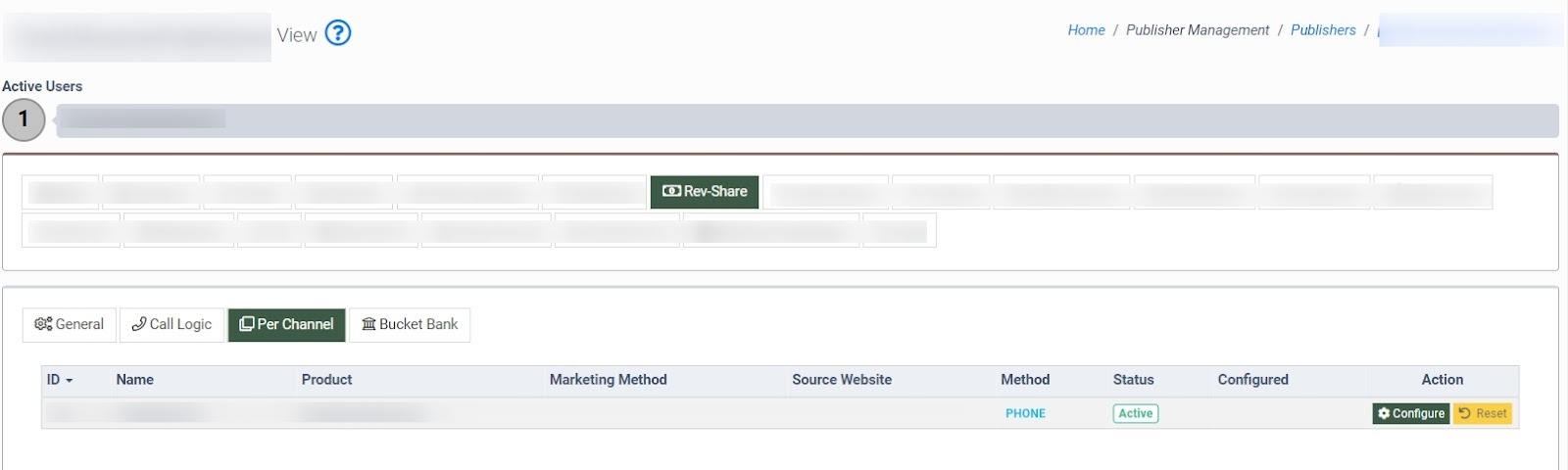
The table shows the list of Publishers’ Channels with Rev-Share settings data.
To manage the existing settings, select the required Channel from the list and click the “Configure” button.
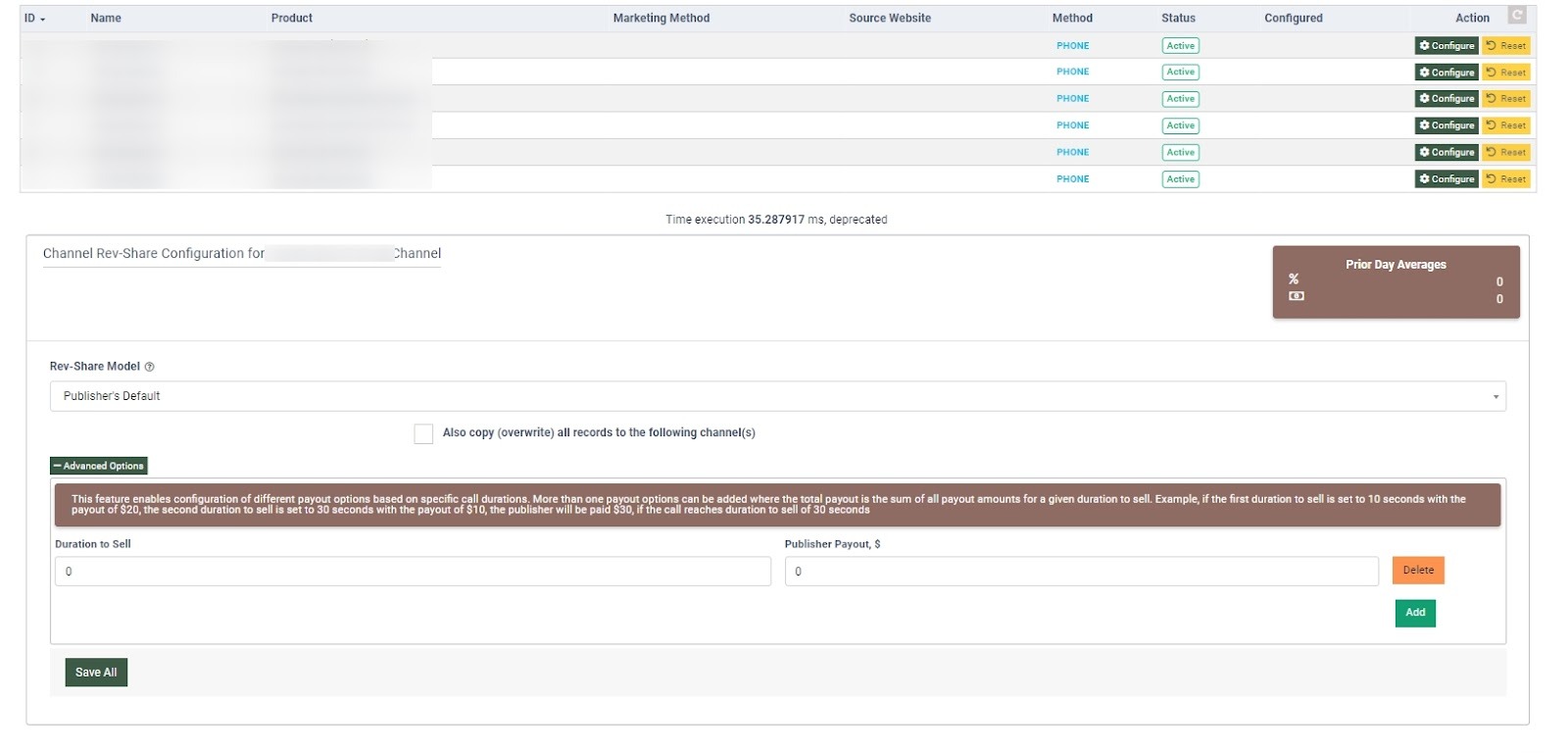
The drop-down block provides the same settings as in the “General” tab - Rev-Share Model, Duration to Sell (Call Logic only), and Publisher Payout. Fill in the data fields and click the “Save All” button to complete.
Use Cases:
- When the “Fixed Price” Rev Share model is used, the leads (fixed price = $10) won’t be presented to Dynamic Campaigns with a low Min Price (Min Price = $5, but the Dynamic Campaign could potentially offer more). You have the ability to set the Fixed Price at $0 in the “General” tab and then configure certain tiers in the “Per Channel” or the “Call Logic” tabs. This way the leads will be presented to Campaigns with a lower Min Price and will be sold based on certain Durations to Sell and tiers set for the Publisher.
- When you know that there is a small number of calls that will exceed a specific duration for the Publisher and you’re willing to pay a higher amount for those calls than the Campaign prices, even at the cost of going negative with the commission. This loss is usually compensated by a large volume of calls sold to the Buyers for a lower Duration to Sell and a lower Campaign Min Price where you can charge the Buyer but do not have to pay the Publisher since their Duration to Sell is not met.
Bucket Bank
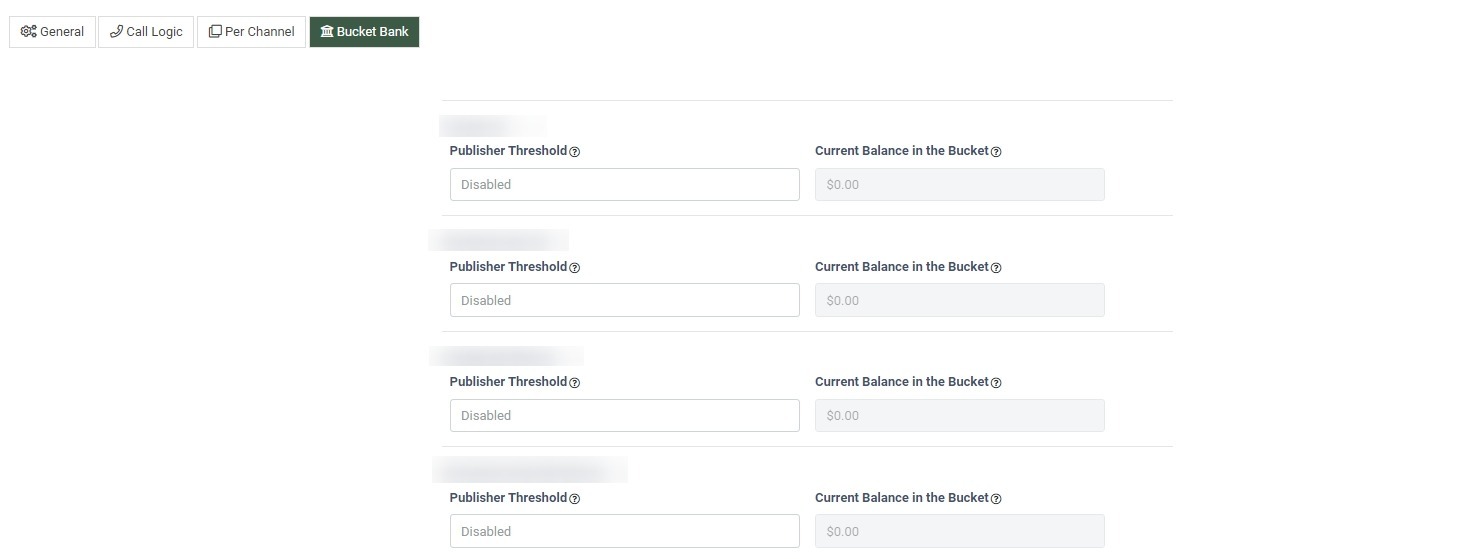
The third tab allows you to configure the Bucket Bank option. Bucket Bank allows you to accumulate a certain amount of money in the Publisher’s balance. In the system, the leads will appear with a “Reject” status, and only when the balance reaches the amount set in the Bucket Bank, a “Sold” status will appear.
Find more details about the Bucket Bank option in the Knowledge Base.
Call Logic
This tab allows you to configure additional and Ping Post Call integration settings for the Publisher's Call Logic component setup. 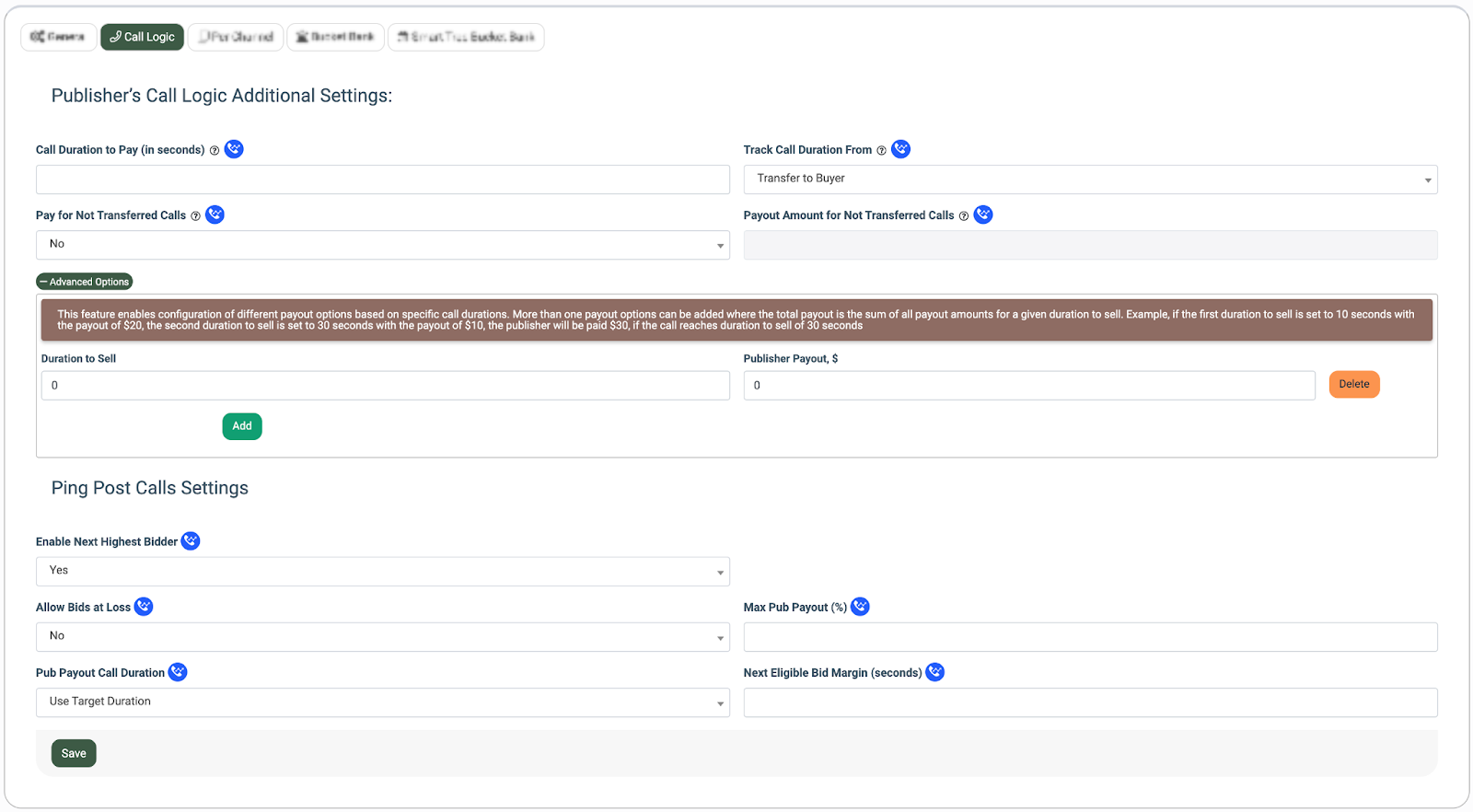
The “Publisher’s Call Logic Additional Settings” block allows you to configure the following settings:
- Call Duration to Pay (in seconds): Enter the call duration in seconds. After the call reaches the set duration, the lead will be marked as “Sold”. Note: This setting overrides the duration to sell on the Campaign level.
- Track Call Duration From: This option allows you to set how the system tracks the call duration to pay the Publisher for a lead. If the “Beginning of Call” option is selected, the duration will be tracked from when a call enters the system. If the “Transfer to Buyer” option is selected, the duration will be tracked from when the call is transferred to the Buyer.
- Pay for Not Transferred Calls: Select “Yes” to pay the Publisher for calls that reached the duration to sell but were not transferred to a Buyer yet.
- Pay Amount for Not Transferred Calls: Enter the payment amount for the Publisher to pay for calls that were not transferred.
The drop-down block provides the same settings as in the “Per Channel” tab - Rev-Share Model, Duration to Sell (Call Logic only), and Publisher Payout. Fill in the data fields and click the “Save” button to complete.
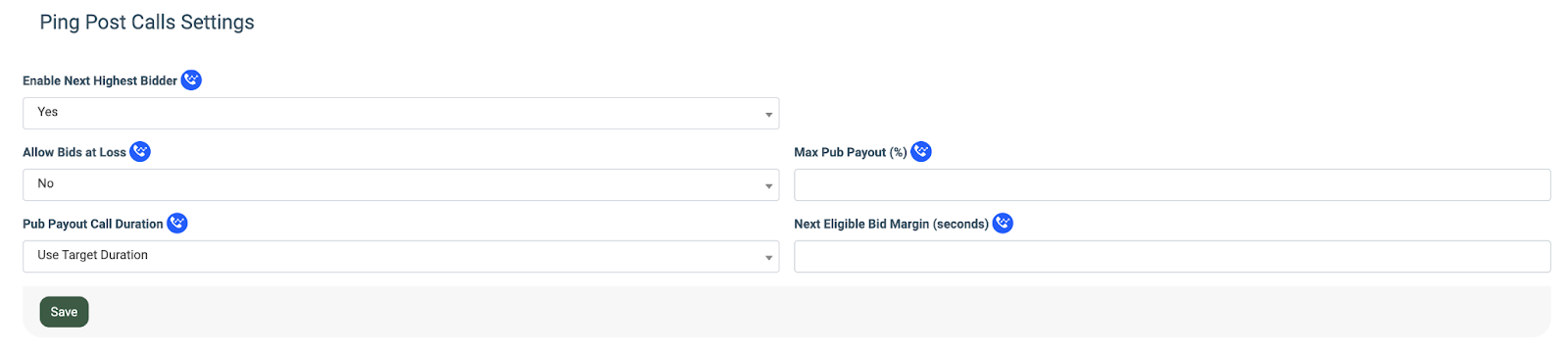
The “Ping Post Calls Settings” block allows you to manage how the system behaves when a call is routed to the highest bidder (Ping Post Calls), but the highest-bidding Buyer does not answer, the number is unavailable, or the call fails for any reason. All configurations in this section are intended to increase flexibility when selling Ping Post calls. They allow the system to store additional bids beyond the highest bidder, providing alternative routing options when the highest bidder is unavailable. They enable adjustments to the admin's earnings and duration to meet selling requirements, helping the system identify additional eligible bids and improve the likelihood of successfully selling the call. In all scenarios, the Publisher payout promise is fixed and must be honored. When we refer to “loss,” this applies only to the admin’s margin, never to the Publisher payout.
Use Case:
When the “Enable Next Highest Bidder” option is enabled:
- A lead enters the LMS component and goes into the Ping Tree.
- The system receives bid responses from all Campaigns.
- If the Ping Post Calls integration returns multiple bids for the same Campaign, the system can retain those additional bids rather than storing only a single bid per Campaign.
- If the highest-bidding Buyer does not answer the call, the system redirects the lead to the next eligible bidder.
Note: The Parallel Pings strategy must be enabled in the LMS Ping Tree for the system to collect and store eligible bids across Campaigns and support Next Highest Bidder routing.
Fill in the following information to configure this option:
- Enable Next Highest Bidder: Select the “Yes” option for the system to attempt to redirect the call to the next eligible bidder if the original buyer fails to accept the call.
- Allow Bids at Loss:
- Select the “Yes” option if the Admin agrees to accept a controlled loss to fulfill the Publisher payout promise. You must define the maximum acceptable admin loss percentage via the “Loss Margin (%)” field.
Example:
Publisher payout: $70
Loss Margin (%): 20%
$70 × 20% = $56. The new minimum bid threshold becomes $56. The system will only consider bids above $56 when selecting the next Buyer. - Select the “No” option for the system to calculate a minimum acceptable bid threshold that ensures that the Publisher receives the promised payout and the Admin does not go below the allowed margin.
Example:
Publisher share: 70%
Maximum original bid: $100
Publisher payout promise: $70
If the winning bidder does not answer, the system must still ensure $70 is paid to the Publisher.
If “Max Pub Payout %” = 90%, the minimum acceptable bid is calculated as: $70 / 90% = $77.77. The system will only consider bids above $77.77 when selecting the next Buyer. - Max Pub Payout (%): Enter the maximum percentage of the bid that can be paid to the publisher when the system selects an alternative Buyer.
Note: Max Pub Payout % cannot be lower than the Publisher payout percentage defined in the rev-share model (e.g., Static Percent).
- Pub Payout Call Duration:
- Select the “Use Target Duration” option for the call duration to match the duration received from the winning bidder, adjusted by the “Next Eligible Bid Margin (seconds)” parameter.
Example:
Winning bidder duration: 60 seconds
Next Eligible Bid Margin: –10 seconds
The system will only consider bidders whose required duration is less than 50 seconds. - Select the “Adjust Target Duration” option for the sale duration to increase if the system attempts redirection. When selected, the “Next Eligible Bid Margin (seconds)” may be positive.
Example:
Winning bidder duration: 60 seconds
Next Eligible Bid Margin: +10 seconds
Each next eligible bidder must have a duration requirement increased by 10 seconds.
- Next Eligible Bid Margin (seconds):
- Enter the negative value for the required call duration to decrease with each subsequent bidder.
Example progression:
Bidder 1 – 60 sec
Bidder 2 – 50 sec
Bidder 3 – 40 sec - Enter the positive value for the required call duration to increase for each next bidder.
Example progression:
Bidder 1 – 60 sec
Bidder 2 – 70 sec
Bidder 3 – 80 sec
- Enable Captcha: Select the option (Yes / No) to enable/disable the audio captcha for Buyer. This setting ensures that the lead has dialed to the real Buyer, not the answering machine.
- Captcha Strategy: Select the captcha strategy (Custom Captcha Code / Generated Captcha Code). Note: Captcha length must be no greater than 5.
- Custom Captcha Code: Enter the custom Captcha code.
- Input Attempts Count: Select the number of attempts the Buyer would have to enter the captcha (1 / 2 / 3).
- Captcha Intro Audio File: Select the captcha introduction audio file.
- Captcha Timeout Audio File: Select the captcha timeout audio file.
- Captcha Reject Audio File: Select the captcha reject audio file.
- Captcha Error Audio File: Select the captcha error audio file. Note: The number of Captcha Errors Audio File fields depends on the value in the Input Attempts Count field.
Note: To upload a new audio file, go to Publisher Management > Setup > Media Library section. Read more in the Knowledge Base article.
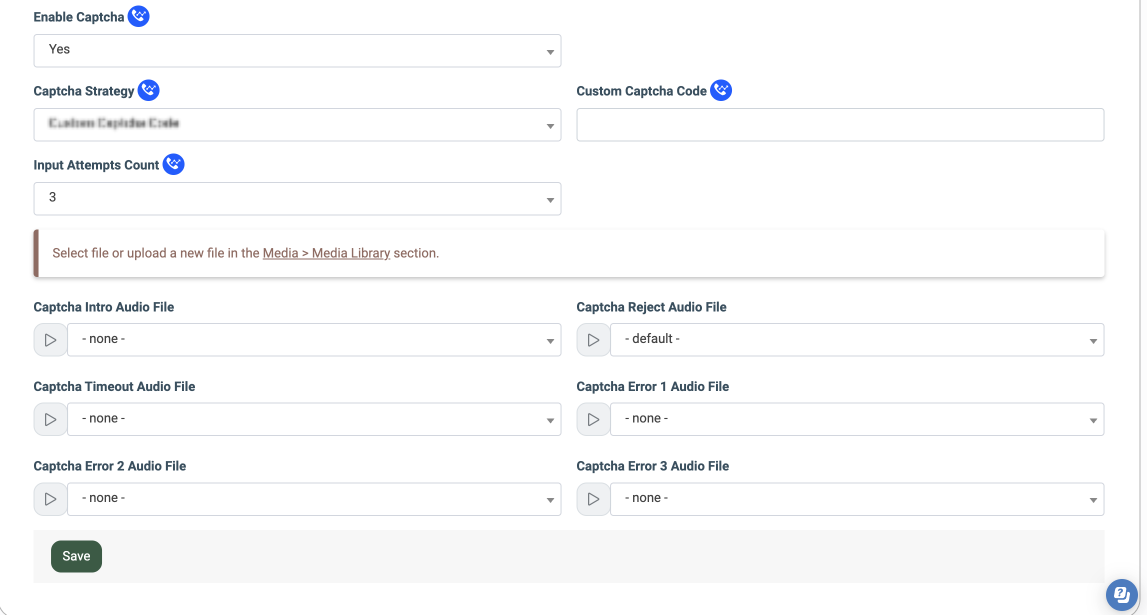
Click the “Save” button to apply changes.
Smart Tree Bucket Bank
This tab allows you to configure the “Smart Tree Bucket Bank” option. This option allows you to cover the missing amount of the Publisher's payout from the Smart Tree Bucket Bank. When the lead is rejected because the sold price cannot cover the payout promised to the Publisher, the amount that might be paid to the Publisher (according to the sold price) will be accumulated in the Smart Tree Bucket Bank. Also, when the Campaign's price on the post is greater than on the ping, the price difference is accumulated in the Smart Tree Bucket Bank.
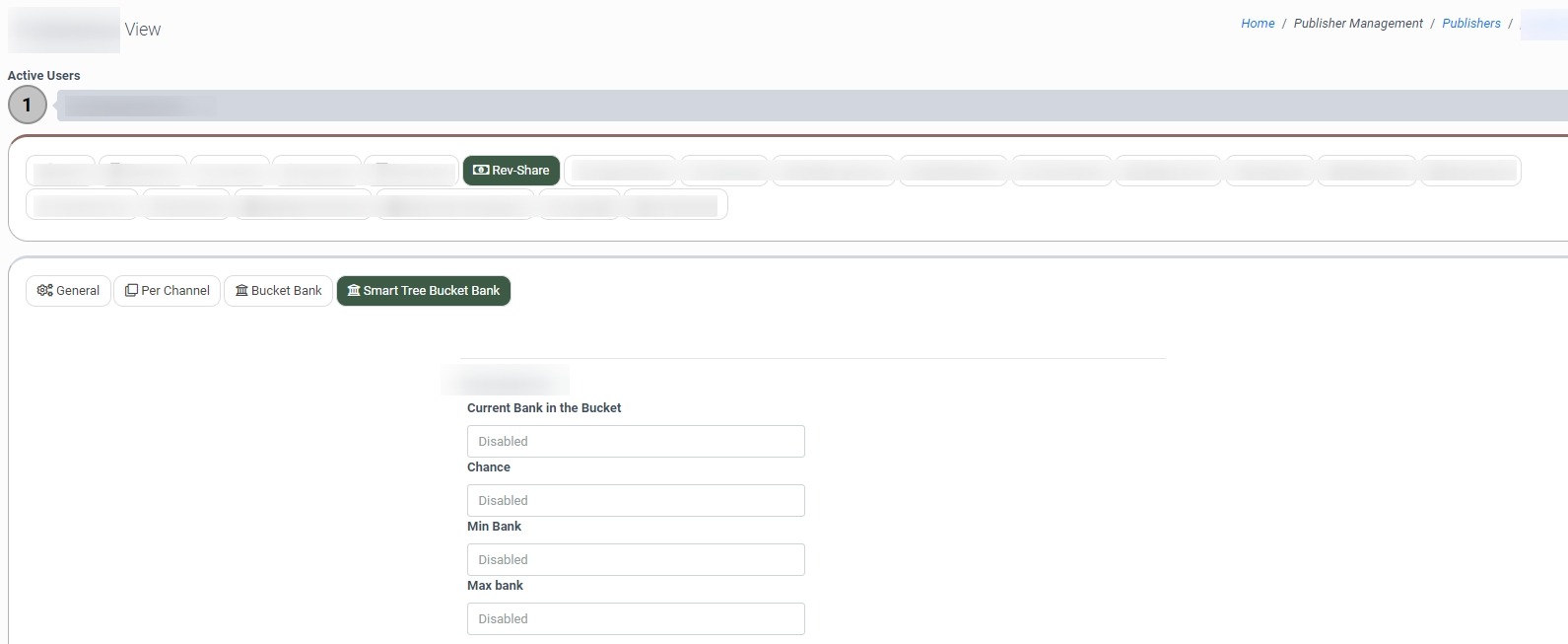
To configure the “Smart Tree Bucket Bank” option for the particular Product, fill in the following fields:
- Current Bank in the Bucket: The amount of money accumulated in the bank at the current moment.
- Chance: The chance that the payout from the bank will proceed (in percent).
- Min Bank: The minimum balance in the bucket (cannot be greater than 0).
- Max Bank: The maximum balance in the bucket. When the balance reaches the maximum level, the accumulation stops.
Click the “Save” button to complete the action.
Read more about the Smart Tree Bucket Bank feature in this Knowledge Base article.